

Imagine a typical Monday morning in a growing company. Client updates are scattered across three different WhatsApp groups. Sales numbers live in one spreadsheet, inventory numbers in another, and the two don’t match the accountant’s figures. A client update that should take five minutes ends up taking thirty.
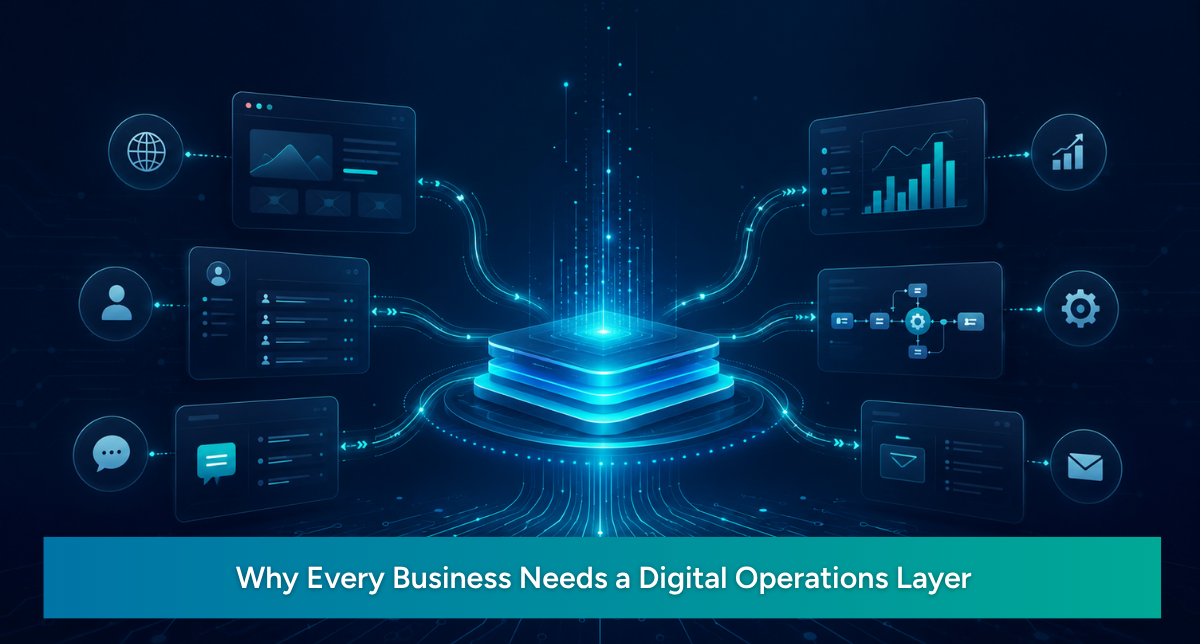
This isn’t a technology shortage. Most businesses today already have a website, a few apps, some kind of CRM, and a handful of spreadsheets holding everything together. What’s missing is the layer that connects all of it: one place where data flows in real time, where routine work happens without someone chasing it, and where the owner can see what’s actually going on without waiting for someone to compile a report.
This is what we mean by a digital operations layer, and it’s quickly becoming less of a nice-to-have and more of a business necessity.
Table of Contents
Digital Transformation Is a Journey, Not a Purchase
A common misunderstanding is treating digital transformation as a single event: buying a CRM, launching a website, subscribing to a new tool. In reality, it’s a progression, and most businesses stop halfway through it.
It typically moves through four stages. First comes IT modernization, getting the basic infrastructure in place. After that, businesses start digitalizing: an invoice gets automated, a lead-capture form replaces a notebook, that kind of thing, one task at a time. The stage many businesses never reach is digital operations, where these individual tools are connected into one intelligent, self-optimizing system. Beyond that lies business model innovation, where the operational clarity gained along the way opens up entirely new ways to serve customers or generate revenue.
Most businesses we work with have completed the first two stages. They have a website. They have some automation somewhere. What’s missing is the layer that connects everything: the actual operations layer.
What a Digital Operations Layer Is Built From
A digital operations layer rests on a few connected pillars, and none of them require a technical background to understand.
Intelligent automation. This goes beyond automating one task at a time. It means orchestrating a full process: an enquiry arriving, being logged, triggering a follow-up, updating a dashboard, all with minimal manual intervention at each step, reducing both effort and human error.
Cloud-based infrastructure. Think about what happens when the one laptop holding all your data goes down, or the one person who manages it takes a sick day. Cloud infrastructure fixes that problem. The whole team can pull up the same accurate information, no matter where they happen to be working from that day.
AI-enabled decision-making. With most systems, someone has to sit down and check the status manually. An AI-enabled system does that watching for you. It catches problems as they show up, suggests what to do about them, and quietly handles the repetitive decisions itself, so the team’s attention goes toward the calls that actually need a person to make them.
Centralized data and visibility. Arguably the most critical pillar. It means consolidating scattered data onto a single dashboard, so the business owner has real-time, accurate figures without piecing information together from five different places.
Together, these four pillars form the operational backbone most growing businesses are missing, not because the tools don’t exist, but because nobody has connected them into a system.
Why the Cost of Waiting Is Higher Than It Looks
The case for building this layer isn’t just about convenience. It shows up directly in cost and risk.
For large enterprises, downtime has been estimated to cost upwards of $9,000 per minute, an extreme figure, but a useful reminder of how expensive disconnected, fragile systems become as a business scales. On the other end, businesses that bring real-time visibility and connected workflows into their operations have reported cost reductions of up to 50% in some cases, simply by removing the manual rework and delays that fragmented systems create.
A more serious threat moves at a slower, quieter pace but matters just as much: businesses that don’t modernize their processes tend to fall behind competitors who respond faster and act on better information.
No-Code: The Entry Point Every Small Business Actually Needs
For years, “digital operations” sounded like something only large enterprises with dedicated IT teams could build. That’s changed, largely because of no-code platforms.
No-code tools let a business build a custom operational system without a developer on staff. A few reasons this matters for growing businesses specifically:
Affordability that scales with you. Instead of a large upfront enterprise investment, no-code solutions typically start small and grow as the business grows, avoiding the financial strain that used to keep this kind of system out of reach.
Built around what you actually need. Off-the-shelf software often comes bloated with features a business will never use, or missing the one feature that matters most for a niche operation. No-code lets a business build exactly what fits its own workflow, particularly valuable for industries mainstream software was never designed for.
Your own team can build it. No-code platforms let people without a development background create functional apps and work directly with structured data, without writing a single line of code. The people who understand the business problem best, often not the IT person, if there even is one, can build the solution themselves.
One source of truth. Instead of disorganized spreadsheets, manual registers, and scattered WhatsApp messages, a coding-free operations platform pulls everything into one live, unified dashboard.
Works for people who are never at a desk. Because these systems live in the cloud, field staff and remote team members can pull up records or update information straight from their phones, no laptop or office required.
Where businesses have implemented this well, the results are hard to ignore. One commercial contracting business used a custom no-code workflow to cut client-update time from thirty minutes to just two or three, saving its field managers roughly eight hours a week. A flooring business replaced scattered text and WhatsApp coordination with a single connected app and processed $7 million in transactions within eight months of adopting it.
None of these were massive enterprises with big IT budgets. They were small to mid-sized businesses that built one connected layer instead of continuing to patch together disconnected tools.
Building This Without Disrupting What Already Works
The businesses that get this right tend to follow a similar, unglamorous discipline. They define clear, measurable objectives before building anything. They invest a little time in training the team rather than assuming the tool will explain itself. They choose systems that can grow rather than ones they’ll outgrow in a year. And they check performance regularly instead of assuming it’s working.
The businesses that struggle usually run into the same three obstacles: old systems that resist connecting to anything new, a team that’s understandably cautious about changing how they work, and legitimate concerns about data security. None of these are reasons to avoid building an operations layer. They’re simply reasons it needs to be planned properly rather than rushed.
Where This Fits Into Your Growth System
At Lamppost Digital, we see AI workflow automation and digital operations as one connected capability, not a separate technical project. The same thinking that goes into building a website that converts, a CRM that reflects reality, and a WhatsApp follow-up system that never lets an enquiry sit unanswered is exactly the thinking that goes into building your operations layer. It’s not about adding more tools. It’s about connecting the ones you already have into a system that runs with less manual effort and more clarity.
If your business feels busy but your data still lives in five different places, that’s usually not a technology problem. It’s a structure problem, and it’s worth reviewing before adding another tool to the pile.
Connecting to the Rest of Your Digital Presence
A digital operations layer does not replace the visible parts of your digital presence — it strengthens them. If you are already working with a digital marketing agency trichy or a digital agency trichy partner, it is worth asking whether your marketing data actually feeds back into one place. The same centralized thinking that improves your operations also sharpens results from performance marketing agency in trichy campaigns, keeps your seo services trichy efforts aligned with real enquiry data, and gives your social media marketing services trichy team visibility into which posts are actually converting.
Let's look at what a connected operations layer could look like for your business.