Most SEO conversations still begin with the same question: “Can you get us to Page 1?”
It is not a wrong question. Rankings matter. They are a signal that your brand is discoverable.
But in 2026, rankings are only a metric. Being chosen is the real outcome.
Because search behavior has changed. People scan results, compare options, and often get answers directly on the results page through AI summaries and zero-click features. They move between Google, YouTube, Reddit, Instagram, and communities before they decide. The journey is not linear. It is a loop of exploration and evaluation until confidence is high enough to act.
That is why modern SEO is not “keywords + content.” It is a connected system of visibility + clarity + conversion.
At Lamppost Digital, we approach SEO as a growth system that earns attention, builds trust, and guides the right people toward an enquiry. A simple framework captures it well:
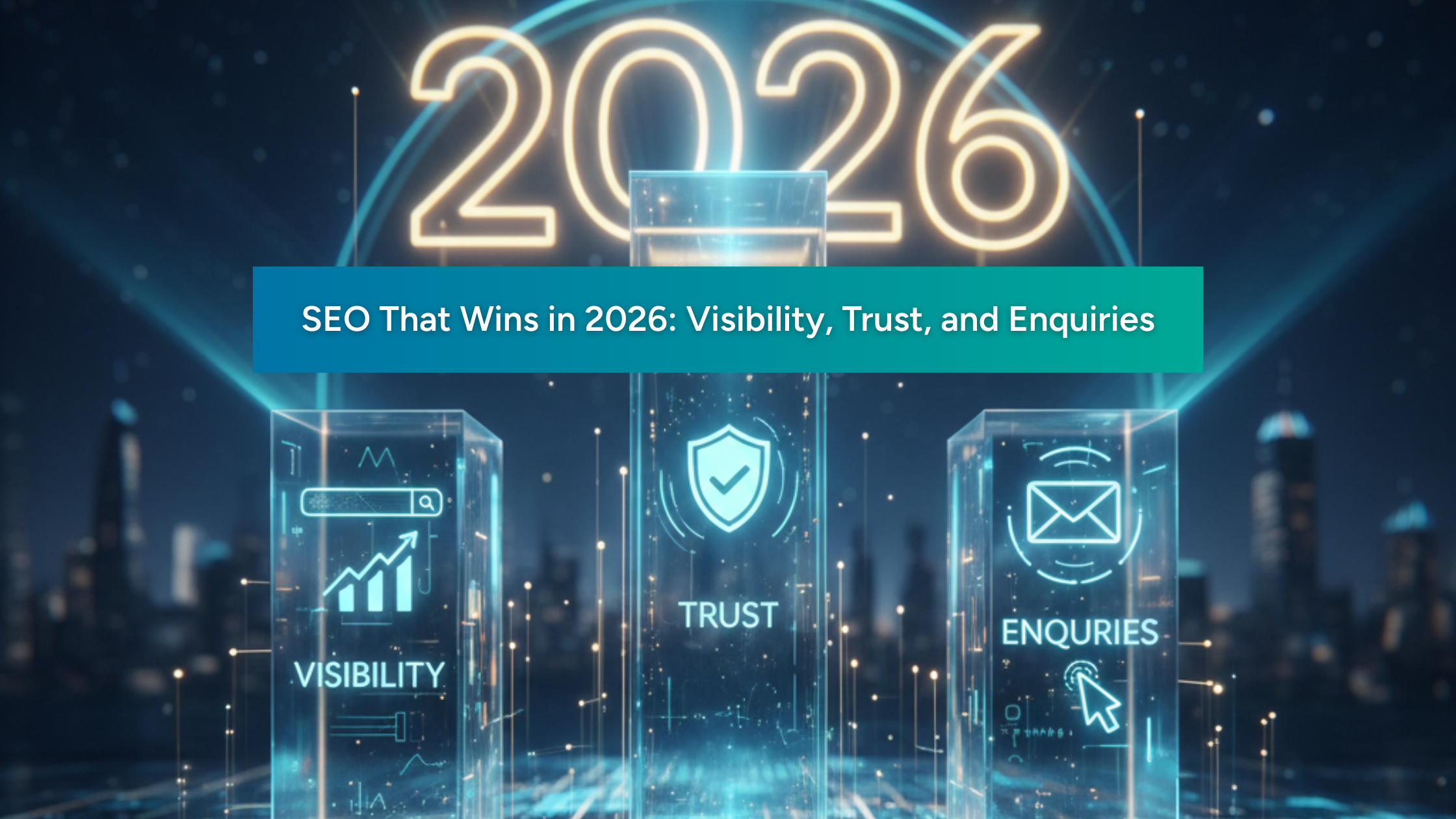
Seen → Chosen → Enquiry
When you build SEO around this path, you stop chasing vanity numbers and start building predictable inbound demand.
Table of Contents
The 2026 reality: Visibility is separated from clicks.
Many businesses are noticing this pattern: impressions go up, rankings improve, but clicks stay flat or drop.
That does not always mean something is incorrect. It often means search is evolving into a decision environment, not only a traffic channel. If your brand occupies meaningful space on the results page with strong snippets, “People Also Ask,” reviews, local pack visibility, video results, and AI summaries, you influence decisions even when users do not click immediately.
So the goal is not to get more clicks at any cost but instead to focus on what is important, which is trust and brand recall.
This is where the Seen → Chosen → Enquiry system becomes practical.
SEEN: Target real buyer intent, not imaginary keyword volume.
The most common SEO mistake is chasing high-volume keywords that do not match buying intent.
High volume looks impressive in a report. But it often attracts students, job seekers, competitors, or casual browsers, not decision-ready buyers.
In 2026, the advantage comes from intent. Two types matter most:
Problem-led searches (the “I need this solved” queries)
These are phrases people type when they are facing a real business problem and want a solution.
Examples:
- “website getting traffic but no leads”
- “SEO not bringing enquiries”
- “How to increase enquiries for interior design business”
- “Google Business profile not getting calls”
These searches are outcome-driven. They are not looking for information alone. They are looking for a path forward.
Location-led searches (the “I want someone reliable nearby” queries)
Even if you serve beyond your city, local intent works as a trust shortcut. People use location terms when they want accountability, speed, and credibility.
Examples:
- “SEO agency in Trichy”
- “website development in Trichy for business”
- “digital marketing company near me for lead generation”
The point is not to sprinkle city names everywhere. The point is to match local intent with a real outcome.
A practical way to find the right phrases
Start with language, not tools.
Write 10 phrases your customers would type when they are close to purchase. Pull them from:
- WhatsApp chats and enquiry forms
- sales calls and objections
- FAQs your team keeps answering
- Google autocomplete and “People Also Ask”
These phrases become your SEO foundation. When you target real intent, you attract the right buyers, not just more visitors.
CHOSEN: Write snippets that earn the click with outcomes and trust.
SEO writing starts on the results page because the click is already a decision.
People scan your title, read the description, and subconsciously ask:
- Does this look relevant to my problem?
- Does this feel credible?
- Will this help me decide?
What a strong snippet needs in 2026
A high-performing snippet usually includes:
- Outcome clarity
Not “SEO services.”
Instead: “SEO that turns visibility into enquiries.” - Trust cues
Process-led, conversion-ready, transparent reporting, local expertise, or proof signals such as reviews. - Decision language
Words that reduce doubt: clear, structured, measurable, trusted, built for outcomes.
Example:
Title
SEO in 2026: Visibility That Turns Into Enquiries | Your Brand
Meta description
Stop measuring SEO by rankings alone. Turn search visibility into enquiries with buyer intent targeting, click-worthy snippets, and conversion-ready pages built for decision-making.
This is not keyword stuffing. It is positioning. If your snippet is vague, your click-through rate drops. When click-through rate drops, your performance usually follows over time. In 2026, clarity is a competitive advantage.
ENQUIRY: Build conversion-ready pages that communicate value in 5 seconds.
SEO can bring the right visitor, and you can still lose the enquiry in seconds.
Why? Because many service pages read like brochures: generic claims, long paragraphs, and no clear next step.
A conversion-ready page has one job: make the visitor feel confident enough to act.
The five-second test
When someone lands on your service page, can they immediately understand:
- What you do
- Who it is for
- What outcome they get
- What to do next
If not, you will keep getting traffic without conversion.
One primary CTA
Too many options reduce action. Choose one primary CTA per page:
- Book a call
- Request a quote
- WhatsApp us
- Start your growth
You can have secondary links, but they should not compete at the decision point.
Proof near the decision point
Do not bury trust at the bottom. Place proof close to the CTA, where hesitation happens:
- 2 to 3 testimonials or review highlights
- a simple 3-step process
- a mini case snapshot with one clear outcome line
- logos or credibility markers (only if genuine)
A service-page structure that consistently performs:
- Outcome-led hero + one CTA
- Who this is for
- What you get and how it works
- Proof close to CTA
- FAQs that remove objections
- Final CTA
Also, mobile experience is not optional. A slow or cluttered mobile page quietly kills enquiries.
The guided journey: Internal links and tracking that measure enquiries
A blog that ranks but does not guide users is a dead end.
In 2026, your website should feel like a guided journey:
- Content builds understanding.
- Internal links guide exploration
- Service pages support decisions.
- tracking measures outcomes
Internal links that move buyers forward
Every blog should link to:
- One relevant service page
- One proof asset if available (case study, results, testimonials)
- One supporting article that deepens confidence
This improves SEO by strengthening topical relevance and improves conversion by giving users a clear next step.
Measure enquiries, not just traffic.
Traffic is not the outcome. Enquiries are.
At minimum, track:
- form submissions
- WhatsApp clicks
- call button taps
- booking conversions
- enquiry source (blog, service page, Google Business, branded search)
This shifts SEO reporting from “how we rank” to “what is creating revenue opportunities.”
Common mistakes that block enquiries
If SEO is not producing leads, it is usually because of one or more of these:
- chasing high-volume keywords that do not match buyer intent
- writing for algorithms instead of decision-ready humans
- unclear service pages that fail the five-second test
- weak mobile experience and slow-loading pages
- No next-step path, so users read and leave.
- measuring only rankings and ignoring enquiry actions
SEO in 2026 rewards connected systems. It punishes disconnected tactics.
Weekly action checklist (simple and practical)
You can run this check weekly in under 60 minutes.
- Capture 10 customer search phrases.
Write them exactly how customers say them. Include problem-led and location-led phrases. - Improve one service page
Focus on the first screen: outcome promise, who it is for, one CTA. - Add one trust element near the CTA.
Choose one: testimonial, review highlight, 3-step process, or one mini result line. - Tighten the CTA wording
Make it specific and low friction. “WhatsApp for pricing and plan” is more clear than “Contact us.” - Connect internal links
Add 2 to 4 internal links from blogs to service pages and proof sections. - Track enquiry source
Review what created enquiries this week, not just what got clicks.
Done weekly, this compounds. SEO becomes an asset that grows stronger each month.
Rankings are a signal. Being chosen is the win.
In 2026, SEO is not about getting found. It is about being selected.
When your brand is standing for the right intent, choosing becomes easier because your message is clear and credible, and guiding an enquiry through a simple path, SEO stops feeling unpredictable.
It becomes a growth system built on clarity, trust, and action.