

Many businesses do digital marketing every month.
They post on social media. They run ads. They work on SEO. They create blogs. They update the website. They send emails. They check reports.
Everything looks active.
But after a few months, the founder may still ask one simple question.
What result is this creating for the business?
This is the point where businesses need to step back and look at the goal before choosing the channel.
The first question should be:
What result should this marketing effort create for the business?
Because when the goal is unclear, digital marketing becomes activity. When the goal is clear, digital marketing becomes direction.
This is not just a practical observation. Research also supports it. CoSchedule’s marketing research found that marketers who set goals are 377% more likely to report success. Gartner also reports that 80% of digital marketing leaders struggle to define consistent metrics and methods for measuring multichannel impact. They are present on many channels, but they are not always clear about what each channel is supposed to do.
Table of Contents
Quick Answer
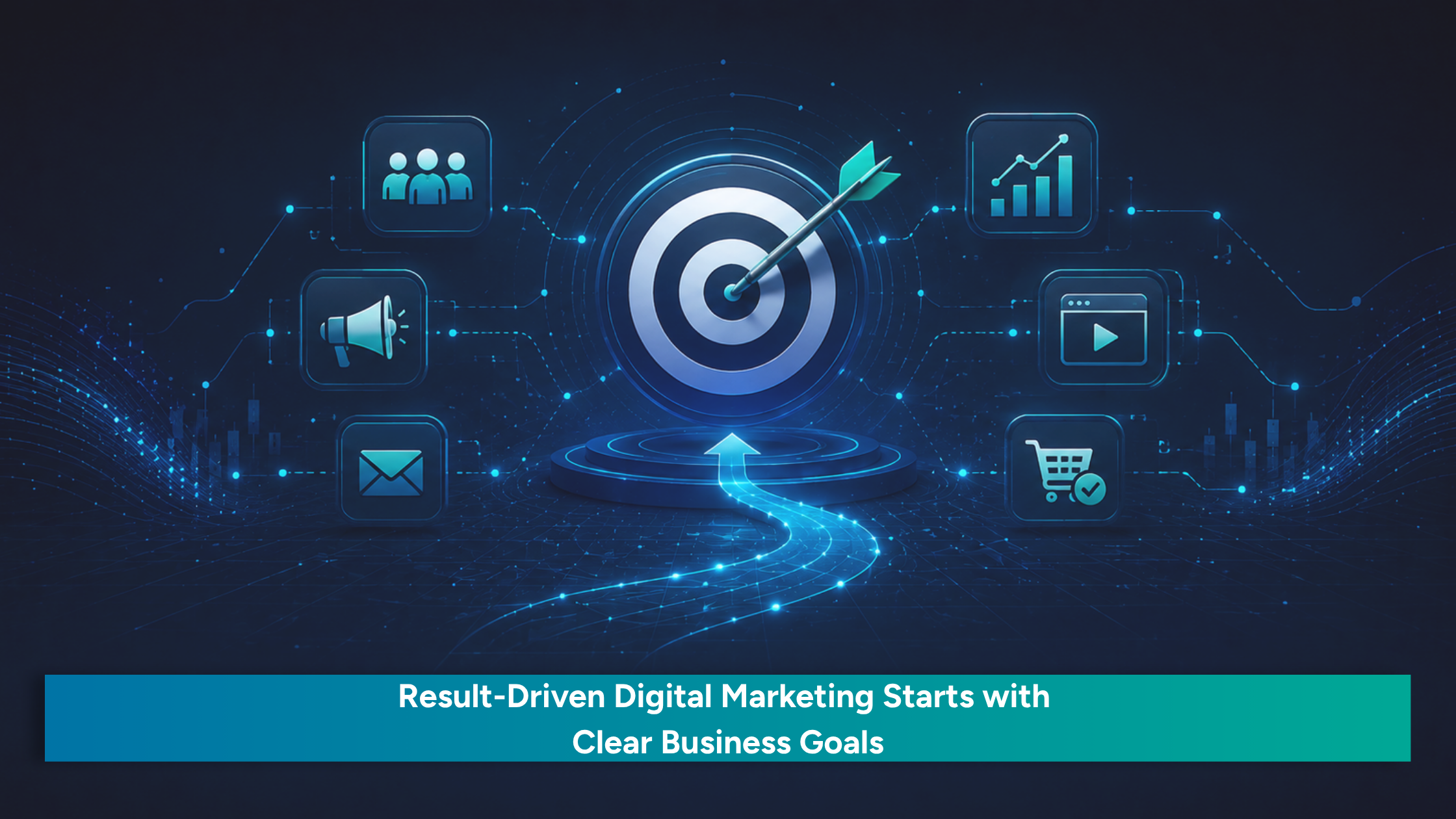
Result-driven digital marketing starts with clear business goals because every channel needs a purpose. SEO, ads, social media, website content, email, WhatsApp, and CRM should not work separately. They should work together to support one clear business outcome such as visibility, enquiries, conversion, or retention.
Marketing Is Not the Final Goal
Marketing matters. But marketing itself is not the final goal.
A business does not need SEO only to improve rankings. It needs SEO to help the right people find its services.
A business does not need social media only to post regularly. It needs social media to build visibility, trust, and recall.
A business does not need performance marketing only to bring traffic. It needs ads to bring relevant enquiries, bookings, sales, or qualified conversations.
A business does not need email only to send updates. It needs email to stay connected with leads, customers, and repeat buyers.
The channel is useful only when the goal is clear.
For one business, Instagram may be used to build brand awareness. For another business, the same platform may be used to bring webinar registrations. For another, it may only support trust before a sales call.
The platform is the same. The goal changes the strategy.
That is why goal clarity matters.
Why Random Marketing Activity Does Not Work
Many businesses are busy online but still do not feel confident about the outcome.
They post because the calendar needs to be filled. They choose paid campaigns out of pressure, not always from a clear business objective.They do SEO because someone said it is important. They create reels because reels are trending. They send emails without deciding what the reader should do next.
This creates movement, but not always progress.
Random marketing usually creates confusion in three places.
The message becomes unclear. Different postings, offers, and campaigns are shown to the audience, yet they don’t comprehend what the company’s key points are.
The team becomes busy without direction. Everyone is doing something, but no one knows which activity is actually moving the business forward.
The reports become difficult to read. There may be impressions, clicks, likes, reach, traffic, and leads, but the founder still may not know what is working.
At Lamppost Digital, this is why digital marketing is not looked at only as posting, ads, SEO, or reports. The starting point is the business goal, the customer journey, and the system needed to move people from visibility to enquiry and conversion.
A Clear Goal Makes the Strategy Easier
A digital marketing strategy becomes easier to plan when the business goal is clear.
A vague goal sounds like:
“We want more leads.”
A clearer goal sounds like:
“Our goal is to bring in right and relevant enquiries per month.”
The second goal gives direction.
It tells the team what to focus on. It also tells the business what to measure.
A clear goal does not have to be complicated. It should simply answer four questions:
What do we want?
By when do we want it?
Which channels or systems will support it?
How will we measure it?
Once these answers are clear, the tactics become easier to choose.
In case brand awareness is the primary objective, there might be a need for such things as education material, social media, videos, and visibility campaigns.
It is important for the generation of enquiries to be taken as the main focus point in which case SEO, landing pages, clear websites, Google Ads, WhatsApp follow-ups, and calls to action become extremely important.
If the goal is conversion, the business may need performance marketing, remarketing, proof-driven content, CRM tracking, and sales support.
If the goal is retention, the business may need email flows, WhatsApp updates, customer education, repeat purchase communication, and lifecycle nurturing.
This is where choosing a digital marketing agency in Trichy, or any digital marketing company, should not be only about who can post regularly or run campaigns. The better question is whether the agency can understand the business goal and build a connected growth system around it.
One Goal Can Use Many Channels
A good digital marketing strategy does not mean using every channel at once.
It involves the correct use of channels, all connected to each other towards a single purpose.
In case the aim is to generate qualified enquiries, the system could work as follows:
The website makes the offer clear.
The SEO allows the correct people to find the company.
Social media creates trust and familiarity.
The Ads attract the correct visitors to the right page.
A proper Email and WhatsApp support follow-up.
CRM tracks the enquiry journey.
Reports show which channel is producing better results.
Each channel has a different role. But all of them support the same business goal.
This is where marketing starts becoming useful as a system.
The customer does not think in channels.
A person may first discover your business through Google. Later, they may visit your website. Then they may see a LinkedIn post. After that, they may send a WhatsApp enquiry. Then they may receive a follow-up email.
For the customer, all of this is one brand experience.
That is why connected marketing matters.
Measure What Matters
Digital marketing gives many numbers.
Reach. Impressions. Clicks. Followers. Website visits. Engagement. Cost per click. Enquiries. Conversions. Revenue.
But not every number matters equally.
IFor awareness, reach and visibility might be the key.
In case of enquiries, web enquiries, call clicks, WhatsApp, and form submissions become important.
Where conversion is concerned, lead quality, response time, follow-up rate, sales conversations, and conversion rate become significant.If the goal is retention, repeat purchases, customer engagement, renewal rate, and relationship communication matter more.
This is why every campaign needs clear KPIs before it starts.
KPIs should not be added only for reporting. They should help the business understand whether the marketing is moving in the right direction.
Before Starting the Next Marketing Activity
Before adding another campaign, channel, or content format, a business should ask:
Does this support a clear business goal?
Do we know what success looks like?
Are we speaking to the right audience?
Is the website ready to convert interest into enquiry?
Is follow-up connected through WhatsApp, email, or CRM?
Are we measuring the right numbers?
Will this activity support visibility, enquiry, conversion, or retention?
These questions help a business move away from random execution and towards practical action.
Final Thought
More marketing does not always create better results.
Better direction does.
When the goal is clear, digital marketing becomes easier to plan, easier to measure, and easier to improve.
Businesses do not need random digital activity. They need result-driven digital marketing that connects visibility, trust, enquiries, follow-up, and measurable business growth.
At Lamppost Digital, this is how we look at digital marketing. The goal is not to do more for the sake of activity. The goal is to build a clear growth system around the business objective.
Because better marketing does not start with more channels.
It starts with clear business goals.
Better marketing starts with a clear goal, not more channels. Let's define what success looks like for you.