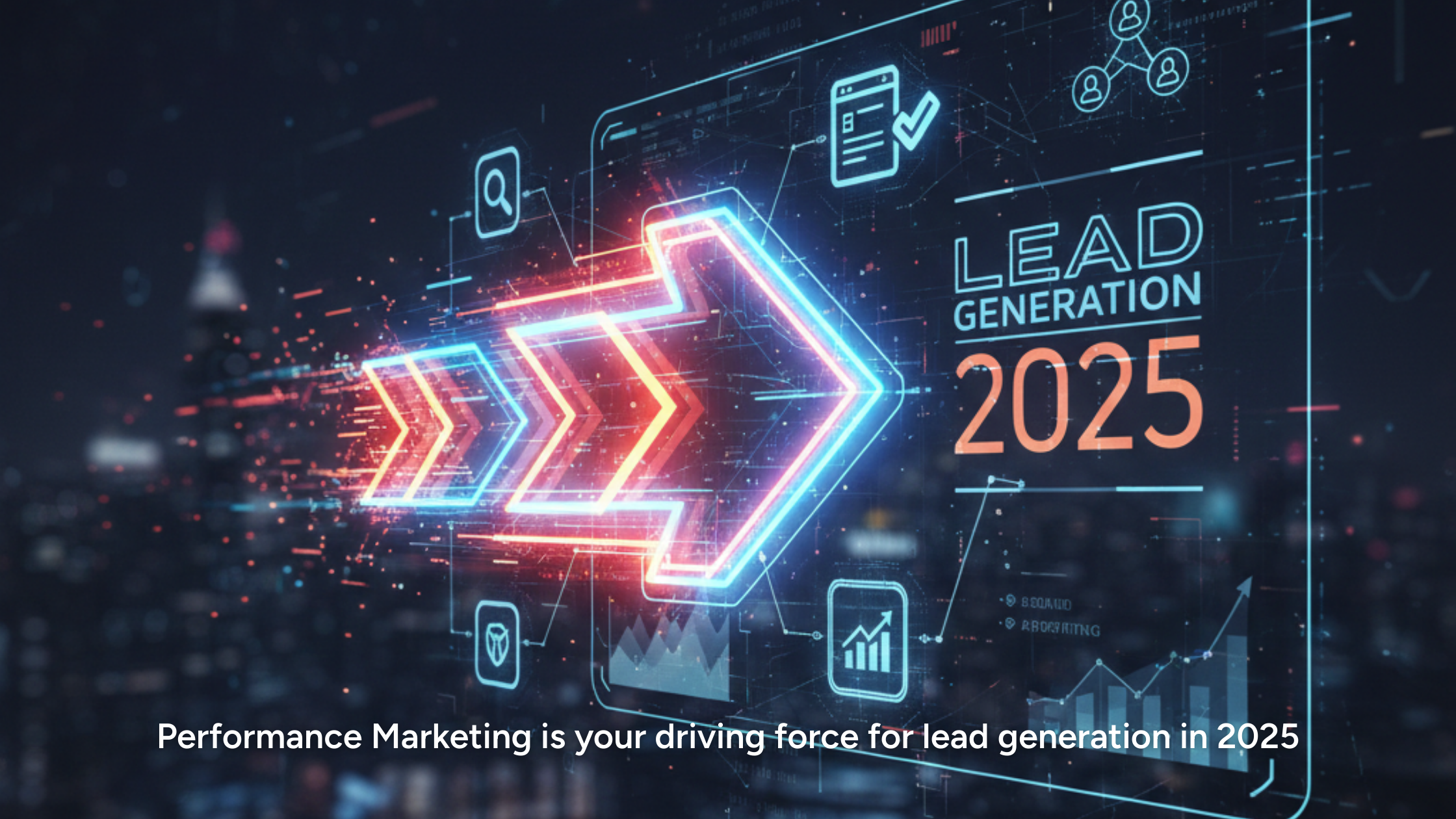
In 2025, most businesses don’t have a “visibility problem.” They have a conversion and consistency problem.
You can post regularly, improve your website, and invest in SEO and still feel like inquiries are unpredictable. Some weeks bring leads, some weeks don’t. The pipeline becomes reactive, and growth becomes stressful.
This is exactly where performance marketing becomes a practical advantage.
Performance marketing is not “running ads.” It’s building a system where you spend with intent and track outcomes—leads, bookings, calls, WhatsApp messages, demo requests, purchases—then continuously optimize toward the best cost and quality.
And in 2025–2026, performance marketing works best when it’s treated as a full-funnel engine:
Audience + Offer + Creative + Landing Experience + Tracking + Optimization.
What performance marketing really means (in simple terms)
Performance marketing is a paid growth approach where every campaign is built around measurable actions—like
- WhatsApp inquiries
- calls
- form submissions
- consultation bookings
- purchases
- demo requests
If you can track it, you can optimize it.
Quick clarity question:
Is performance marketing only for big budgets?
No. Performance marketing is about efficiency. Even small budgets can work when you narrow the audience, tighten the message, and improve the conversion layer.
Why performance marketing matters more in 2025–2026
1) Because attention is expensive
Organic reach is unstable across platforms. Paid acquisition becomes the fastest way to generate demand—especially when SEO takes time.
2) Because businesses need predictable pipelines
Instead of hoping inquiries come in, you build a repeatable engine:
- spend → leads → follow-up → conversion → learn → improve
3) Because “speed to lead” is now a competitive edge
Performance marketing works best when teams pair it with a clear response system—CRM or WhatsApp automation—to prevent leads from going cold.
The 7 levers that decide whether your ads generate leads or waste money
Level 1: Start with one clear lead goal (not “more business”).
Pick one conversion action per campaign:
- “Book a call”
- “Get quote on WhatsApp”
- “Request proposal”
- “Schedule consultation”
When the goal is fuzzy, targeting and creatives become generic.
Level 2: Your offer must be easy to say “yes” to.
In 2025, people don’t respond to “We provide services.”
They respond to:
- outcomes
- clarity
- process confidence
- proof
Examples of stronger offers:
- “Free 15-minute audit call”
- “WhatsApp quote in 10 minutes”
- “2 package options + pricing range shared after 3 questions”
The simpler the first step, the higher the lead volume.
Level 3: Creative is the targeting now.
Platforms reward what people engage with. And people engage with what feels
- specific
- relatable
- proof-backed
- easy to understand
A good creative angle usually falls into one of these buckets:
- Problem → consequence → solution
- Before/After
- Myth vs. reality
- Checklist / quick guide
- Case study snapshot
- Founder POV
You don’t need 50 creatives. Build and test 6–10 strong creative variations systematically.
Level 4: Landing page experience decides your CPL.
Even the best ad fails if the landing page is slow or unclear.
One of the most practical performance insights is this: when load time increases from 1 second to 3 seconds, bounce probability rises significantly. (Google Business)
So performance marketing is not only “ads.” It includes:
- fast mobile experience
- one clear CTA
- proof near the CTA
- short forms
- clear “what happens next”
Level 5: Tracking must be clean (or optimization becomes guessing).
If you don’t track:
- WhatsApp clicks
- call clicks
- form conversions
- booking actions
…then you can’t confidently say what’s working.
In 2025, tracking is part of performance marketing, not optional.
Practical move: track one primary conversion per campaign first. Then add secondary conversions later.
Level 6: Use smart bidding and platform automation intentionally.
Both Google Ads and other platforms increasingly rely on AI-driven optimizations. For example, Google Ads’ Smart Bidding uses Google AI to optimize for conversions at auction time.
But automation works best when you give it:
- enough conversion signals
- clean tracking
- stable creatives
- a landing page that converts
If your conversion layer is weak, Smart Bidding can optimize “cost per click” instead of “cost per lead quality” indirectly.
Level 7: Retargeting brings back warm intent.
Most visitors won’t convert on the first touch. Retargeting is how you convert “almost buyers.”
You can retarget:
- website visitors
- video viewers
- people who engaged with ads
- people who opened forms but didn’t submit
Meta explicitly recommends building audiences like engagement custom audiences for lead ads (for example, people who started an instant form but didn’t finish).
Retargeting often delivers the best CPL and highest lead quality because you speak to people who already know your brand.
A simple performance marketing structure that works for lead generation
Step 1: Choose one campaign objective per service.
Example:
- SEO service leads
- website development leads
- social media management leads
Don’t mix everything into one ad set.
Step 2: Run two campaigns (not ten).
- Lead capture campaign (WhatsApp / forms / bookings)
- Retargeting campaign (warm audiences)
Step 3: Test 3 variables only (avoid chaos).
- Creative angle (3 versions)
- Audience segment (2 versions)
- Landing CTA (1 change at a time)
This gives you clarity faster.
Common mistakes that make performance marketing “feel like it doesn’t work”
- driving traffic to a generic homepage
- too many CTAs and no single next step
- weak offer (no reason to act now)
- long forms, especially on mobile
- no proof near CTA
- Tracking isn’t clean, so optimization is blind.
- no follow-up system after leads arrive
Many brands blame their ads, but the real leak usually comes from the landing experience and slow follow-up.
A practical 14-day optimization plan (fast, realistic)
Days 1–3: Foundation
- define one conversion action
- ensure tracking is correct
- Align ad promise to landing page promise
Days 4–7: Testing
- Test 3 creatives minimum
- Keep the audience tight.
- Watch CTR + lead quality (not only CPL).
Days 8–14: Improve the conversion layer
- shorten form / simplify WhatsApp flow
- Add proof near CTA
- Improve mobile speed if needed
- retarget visitors and engagers
One strong improvement cycle is better than running new campaigns every week.
Conclusion
In 2025–2026, performance marketing is not about “spending more.”
It’s about building a system that converts attention into inquiries—predictably.
If your business wants consistent leads for SEO, websites, or social media services, performance marketing becomes your growth engine when it’s paired with:
- a clear offer
- strong creatives
- a CRO-ready landing experience
- clean tracking
- and an improvement loop