

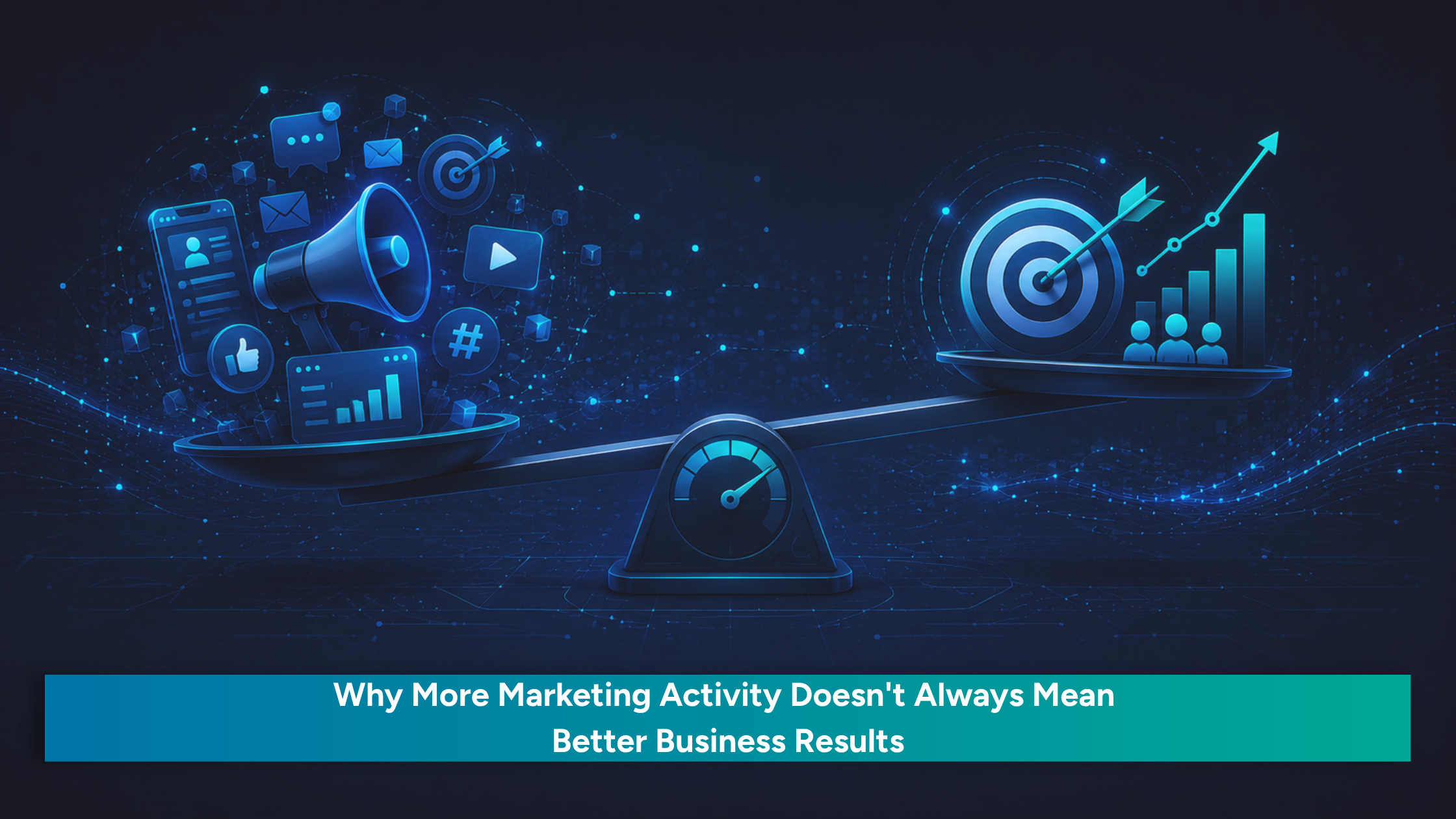
Being busy isn’t the same as making progress.
A full marketing calendar can still leave a business unsure about what is working. There may be regular posts, paid campaigns, email activity, website updates and a growing dashboard of numbers. But if those actions are not connected to a clear business goal, more activity can create more work without creating better decisions.
Result driven digital marketing starts with a simple question: what should this activity help the business achieve? The answer may be qualified enquiries, bookings, sales, retention or a clearer understanding of which audience and offer deserve attention. Once the result is clear, marketing becomes more focused and easier to evaluate.
Table of Contents
The Activity Trap
Marketing outputs are easy to count: posts published, ads launched, emails sent, videos produced and website visits gained. These numbers show that work is happening, but they do not prove that the work is helping the business.
An advert can bring clicks without enough qualified conversations. A video can attract views without leading the viewer towards a relevant next step. A website can receive visitors while leaving the offer or enquiry path unclear.
Separate the work into three layers:
- Activity: what the team publishes, launches or sends.
- Response: reach, engagement, clicks, visits or form starts.
- Business outcome: qualified enquiries, bookings, sales, repeat actions or useful learning.
Consider a hypothetical service business that publishes regularly, runs lead ads and sends monthly emails. It receives enquiries, but many are outside its service area or ask for an option the business does not offer. The advert makes a broad promise, the landing page explains several services at once and no one clearly owns follow-up. The business is active, but the activity is not connected.
The business could choose one priority outcome, such as qualified consultation requests. Its content could clarify the customer problem, the campaign could reach the relevant audience, the landing page could explain one offer, and a named team member could own each enquiry through follow-up. The improvement is not automatically “more marketing”; it is a clearer connection between each action and the result.
Why Strategy Comes First
A marketing strategy is not simply a list of channels. It is a set of decisions about the audience, offer, message, channel, conversion path and ownership.
Before adding another platform or increasing the content schedule, ask:
- Which business goal has priority right now?
- Who needs to understand or trust the offer?
- What action should a suitable prospect take?
- What happens after that action?
These questions prevent disconnected execution and give the team a reason for each activity. That makes performance easier to evaluate against a business decision rather than personal preference.
For a related founder perspective on connected growth, read how a connected growth system supports business results.
The Founder Lens: Can You Explain What Marketing Is Helping the Business Achieve?
Founders do not need to inspect every platform metric personally. They should, however, be able to see the priority behind the work, the customer journey it supports, the person responsible for the next step and the business action that follows.
If a team cannot explain why a campaign is running, what a visitor should do next or who owns the resulting enquiry, the issue may not be effort. It may be a gap in direction and ownership. A short review of these four points can help a founder decide whether the next move is to improve the message, repair the conversion path, strengthen follow-up or continue with the current plan.
Marketing Should Support Business Goals
Marketing should not sit apart from sales, delivery or customer experience. It should help a real business priority move forward.
If the goal is qualified enquiries, content and campaigns should make the offer clear and provide a straightforward next step. If the goal is bookings or sales, the page, follow-up and checkout should support that decision. If the goal is retention, communication should help existing customers continue using or renewing the service.
Every channel does not need to do everything. Search may support discovery, a focused campaign may support a launch and useful content may build trust over time. The right mix depends on the audience, offer, sales cycle and current capacity.
Outcome map: Business goal → audience and offer → channel role → landing page or conversion path → enquiry/follow-up owner → measure to review.
Search visibility and enquiry intent should lead to a page that explains the offer and supports the next action. The website experience and conversion path are part of the result too. Without that connection, more visibility may only create a larger queue.
Measure Before Scaling
Scaling can mean increasing the budget, publishing more often, extending into another channel or adding more tools. It should happen after the team knows what is worth repeating—not only because activity feels slow.
Measurement is a recognised challenge across marketing teams. Nielsen’s 2025 Annual Marketing Report, based on a survey of 1,400 leading marketers around the world, reported that 32% of marketers measure traditional and digital media spend holistically. This describes media-spend measurement, not the performance of every small business, but it reinforces the need to connect channel data with the customer journey before scaling.
Start with a baseline and choose one primary outcome. Then track a small set of supporting measures:
- The primary outcome, such as a qualified enquiry, booking, sale or repeat action.
- Supporting signals, such as visits, click-throughs, form starts, cost or response time.
- Quality checks, such as audience fit, enquiry source, next step and conversion status.
The emphasis will differ by business model. A high-value service may care more about qualified conversations than raw lead volume. An early-stage offer may first need evidence that the message is attracting the right interest.
Review what happened after the initial response. Which source brought suitable people? Where did people stop? Did the sales or follow-up process receive what marketing promised? If those questions cannot be answered, improve tracking or the conversion path before increasing output. Lamppost Digital’s performance marketing approach connects campaigns with audience, landing pages, tracking and meaningful actions.
Continuous Improvement
Improvement is not constant change. It is a controlled cycle:
- Observe: review the agreed measures and response quality.
- Interpret: identify where the journey is helping or losing people.
- Adjust: change one meaningful part of the message, audience, page or process.
- Test and document: give the change time to produce evidence, then record what was learned.
The pattern of the problem can guide the next improvement. If impressions rise but enquiries do not, inspect the page promise, call to action and form. If clicks are strong but lead quality is weak, revisit the audience and message. If enquiries are relevant but follow-up is slow, improve the hand-off and ownership.
This gives business growth a clearer operating rhythm. The team can make a focused change and use evidence to decide what deserves more attention.
Common Questions Before Scaling Marketing Activity
What does result-driven digital marketing mean?
It means connecting marketing activity to a defined business result—such as qualified enquiries, bookings, sales, retention or useful learning—then assigning each channel a role and reviewing evidence before changing or scaling the work.
How do I know whether marketing is working?
Start with the priority business outcome and trace the journey from source to next action. Review the quality of enquiries, conversion progress, follow-up ownership and supporting signals such as visits or clicks. Activity numbers are useful context, but they should not replace evidence of business progress.
When should a business increase its marketing budget or activity?
Increase it when the offer, audience, conversion path, follow-up ownership and measurement are clear enough to show what is being repeated. If the team cannot explain where suitable prospects come from or what happens after they respond, fix that gap before adding more activity.
Build Marketing That Supports a Clear Business Result
Better business results do not come from the busiest marketing calendar. They come from choosing activity with a job, measuring what happens after it and improving the path between attention and action.
Result-driven digital marketing is about directing effort towards a result that the business can recognise and act on. That makes marketing more useful to founders, teams and customers.
A Practical, Connected Approach
Lamppost Digital is a growth systems and automation partner with a Trichy-based team. Its connected expertise brings together websites, marketing, tracking, CRM and WhatsApp workflows so businesses can manage visibility, enquiries and follow-up with clearer ownership. The approach is practical and journey-first: clarify the business result, connect the customer path and add systems where they support better decisions.
If your marketing activity feels busy but its contribution to the business is unclear, let's
review the next practical step together.