

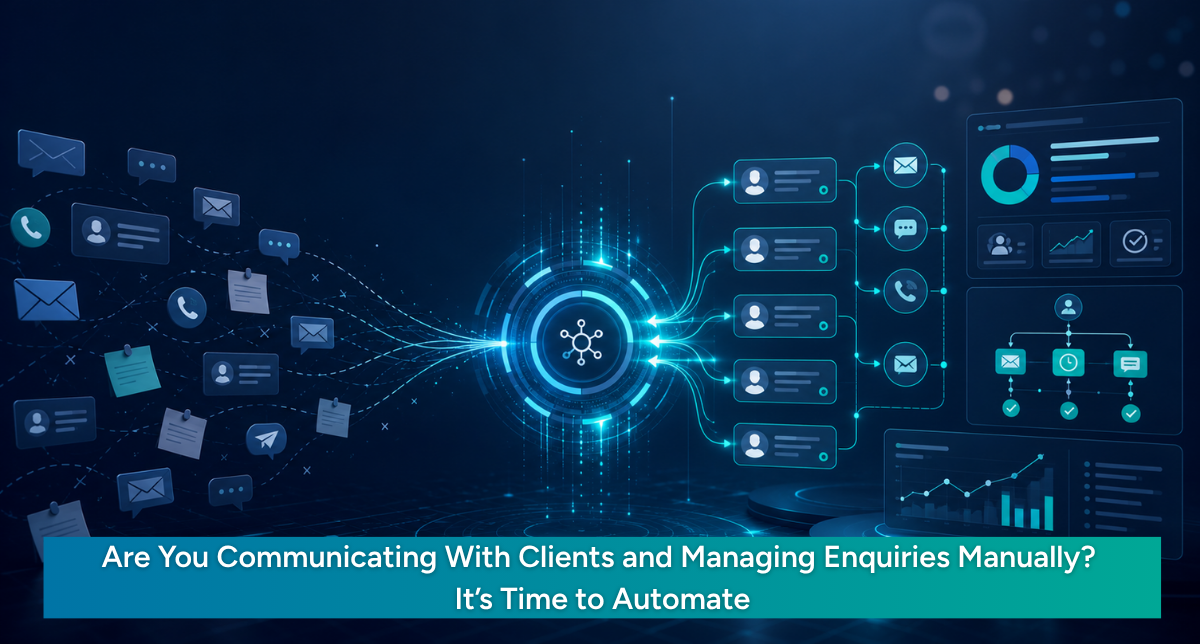
Introduction: Manual Communication Can Slow Business Growth
A lot of businesses still run their enquiries the same way they did on day one: WhatsApp chats, phone calls, a notebook by the desk, maybe an Excel sheet, and a good memory holding it all together. Early on, that works fine. There aren’t many enquiries, and one person can keep track of most of it in their head.
The trouble starts as things grow. More enquiries mean more chances for a reply to get delayed, a follow-up to slip through, or a genuinely interested customer to lose patience and go elsewhere. None of this means the team isn’t working hard. It usually means the structure around communication hasn’t kept pace with the volume.
Automation isn’t about replacing the conversations that matter. Good business process automation services are a practical support system, handling the repetitive parts so the team’s time goes toward the enquiries that actually need a person.
Table of Contents
Why Businesses Lose Leads
Enquiries Come From Too Many Places
Website forms, WhatsApp, Instagram, Facebook, a Google Business Profile listing, phone calls, referrals, walk-ins. Each one is a legitimate way a customer reaches out, and each one is another place a lead can quietly get lost if there’s no single system pulling them together.
Follow-Ups Depend on Memory
A team member replies once, gets pulled into something else, and never circles back. Meanwhile, the customer who was genuinely interested finds a competitor who responded faster.
No One Tracks Lead Status Clearly
Ask most small businesses which leads are new, which are pending, which converted, and which went cold, and you’ll usually get a shrug. That information exists somewhere, scattered across chats and memory, but rarely in one place anyone can actually check. A proper lead management system is what closes that gap.
Common Communication Leaks
Delayed First Response
A slow first reply chips away at trust before the conversation has even really started.
Repeated Customer Questions
Teams spend real time each day typing out the same answers to the same handful of questions.
Missed Follow-Up Windows
Most customers don’t decide after one message. They often need a second or third nudge, and that’s exactly the step that gets skipped when there’s no system prompting it.
No Clear Ownership
When anyone on the team might reply to anyone, it’s easy for an enquiry to sit there with nobody quite sure whose job it was to follow up.
Why WhatsApp Alone Is Not Enough
WhatsApp is useful. It’s familiar, it’s fast, and customers already have it open. But chats get buried, especially once volume picks up, and WhatsApp on its own doesn’t give a business real visibility into where a lead came from, what its follow-up status is, whether it converted, or who’s actually handling it.
WhatsApp gets a lot stronger once it’s connected to a CRM and some automation behind it, rather than being asked to function as a database it was never built to be.
CRM + WhatsApp + Automation: How They Work Together
This is really what whatsapp crm integration means in practice: three pieces working as one system instead of three separate habits.
CRM Captures and Organizes Leads
A CRM holds customer details, where the lead came from, what they’re asking for, and where things currently stand, all in one place instead of scattered across chat threads. Set up properly, with good crm integration services connecting it to the channels enquiries already come through, nothing has to be entered twice.
WhatsApp Supports Quick Communication
It’s still the fastest way to send acknowledgements, share service details, send reminders, and follow up, once there’s a system behind it keeping track of what’s been said.
Automation Reduces Repeated Manual Work
Instant replies, follow-up reminders, appointment confirmations, and routine updates can go out automatically, freeing the team from retyping the same message for the hundredth time.
What Can Be Automated
Most of this falls under straightforward whatsapp business automation, plus a few adjacent touchpoints:
- Website form acknowledgements
- WhatsApp enquiry responses
- Lead assignment to team members
- Follow-up reminders
- Appointment confirmations
- Payment reminders
- Course or consultation reminders
- Review requests
- Monthly enquiry reports
What Should Still Stay Human
- High-value sales conversations
- Sensitive customer concerns
- Relationship-based follow-ups
- Final decision discussions
- Complex service explanations
Frequently Asked Questions
Do I need a CRM if I only get a handful of enquiries a week? Probably not yet. A CRM starts paying off once enquiries come from more than one or two channels, or once you notice replies and follow-ups slipping through. If you’re still tracking everything comfortably in your head, there’s no rush.
Will automation make my replies feel robotic? Not if it’s used for the right things. Automation handles acknowledgements, reminders, and routine updates well. Anything that needs real judgment, like a high-value conversation or a sensitive concern, should still go through a person.
What’s the difference between using WhatsApp and using a WhatsApp CRM? WhatsApp on its own is just the conversation. A WhatsApp CRM adds the missing layer underneath it: lead source, follow-up status, ownership, and a record of what’s already been said, so nothing depends on memory.
How long does it usually take to set up an enquiry management system? It depends on how many channels need to be connected and how complex the follow-up process is, but most small business setups can go from scattered chats to a working system within a few weeks, not months.
Can I automate follow-ups without it feeling pushy to the customer? Yes. A well-timed reminder two or three days after a quiet enquiry usually reads as helpful, not pushy, especially if the tone stays conversational rather than sounding like a mass broadcast.
Conclusion
Manual enquiry management can work fine when the numbers are small. It doesn’t hold up as a business grows. What’s needed isn’t more effort from the team, it’s a structured system that actually captures, tracks, responds to, and follows up on enquiries properly, instead of relying on memory and good intentions.
This is exactly where CRM, WhatsApp, and automation come together as one connected system rather than three separate tools. At Lamppost Digital, this is the kind of structure our crm setup services are built around, fitting into a business’s existing communication channels rather than replacing them, so the enquiries already coming in have somewhere real to land.
Manual enquiry management won't scale with you. Let's build a connected CRM and WhatsApp system that does.