
A research-style guide for founders, marketing teams, and growth leaders
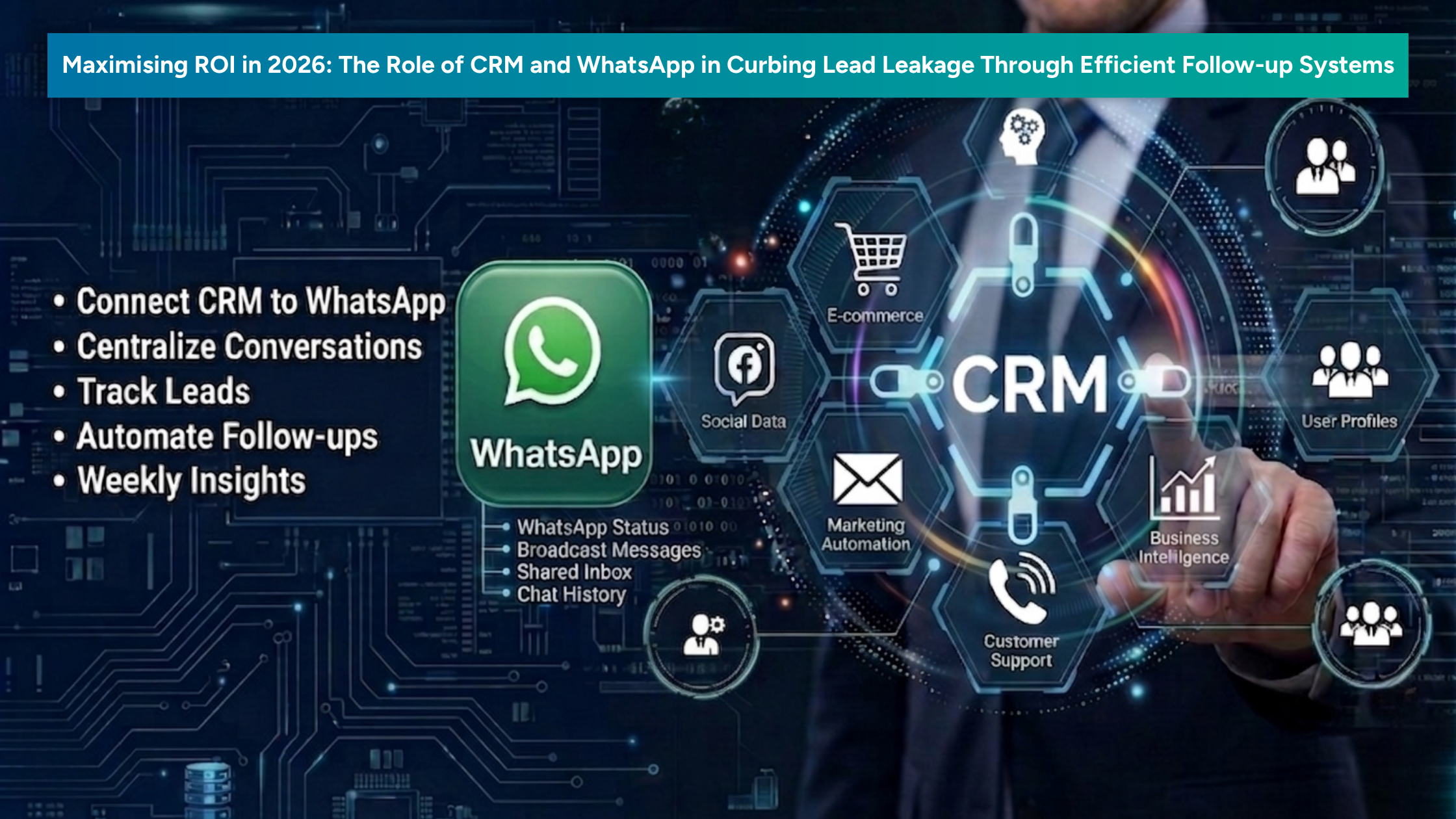
CRM and WhatsApp for lead follow up help businesses reduce lead leakage, respond faster, and improve ROI through a more reliable enquiry handling system. This matters because leads are often lost after the first interaction when follow-up is delayed, scattered, or inconsistent. In this blog, you will understand where lead leakage happens, how CRM and WhatsApp work together, and which simple follow-up systems help turn more enquiries into customers in 2026.
A lead may come in from Instagram, while a website form submission may arrive through an ad. At the same time, a WhatsApp message may land after a Google search. If an enquiry call comes in during business hours, the intent is clear: the customer wants a response.
“That is where lead leakage begins. Sometimes the message gets buried inside a chat thread, and sometimes notifications push it down. As a result, someone forgets to reply or the business responds too late. In many cases, follow-up never happens, so the customer chooses a provider who responds faster and guides them more clearly.”
Table of Contents
Lead leakage is a revenue problem, not a lead generation problem
- How many leads did we get?
- What was the cost per lead?
- How much reach did we generate?
But in real operations, ROI depends more on what happens after the enquiry:
- How fast did we respond?
- Did we qualify the lead?
- Did we follow up multiple times?
- Did we guide them to the next step?
- Did we track movement and closure?
A business that generates 100 leads and loses 40 due to delay and inconsistency wastes budget, effort, and opportunity. A business that generates 60 leads and converts 20 through strong follow-up often grows faster.
In 2026, lead handling becomes the growth advantage.
Research insight: Leads leak in predictable places
Lead leakage doesn’t happen randomly. Instead, it follows predictable patterns. Once you identify these weak points, you can fix them much faster.
1) No response
Leads arrive through WhatsApp, Instagram DMs, forms, and calls. However, if no one responds, the lead disappears. In many businesses, this happens more often than expected, especially when enquiries come through multiple channels.
2) Delayed response
A reply that comes hours later can feel like no reply at all. As a result, the customer may move on to a competitor. In high-competition markets, the first responder often wins more deals than the brand with the better campaign.
3) Weak follow-up discipline
Many teams reply once and then stop. In reality, conversions often need 3 to 7 touches, including a reminder, clarification, proof point, or next-step prompt. Without a system, teams forget, and leads lose momentum.
4) Leads scattered across channels
When leads sit across WhatsApp, Instagram, email, and call logs, teams lose visibility. Teams encounter challenges because they must track leads while maintaining contact with prospects and they must restart sales discussions.
5) No clarity on next steps
The teams provide responses to customer inquiries but their answers do not assist customers. However, leads do not convert just because you replied. Leads become clients when you direct them to specific actions which include a call or a booking or a visit or a payment or a demo.
Overall, a strong follow-up system solves all five leak points
What marketing automation means in 2026 (simple and practical)
Many businesses associate automation with complexity. In reality, automation in 2026 is simple.
Marketing automation means reducing manual dependency and creating consistent execution. In simple terms, it helps ensure that every enquiry receives a quick acknowledgement, the lead gets basic information automatically, the team tags and routes the lead correctly, and follow-up happens on time. In addition, you can track each lead’s stage inside your pipeline, so reporting becomes decision-ready rather than reactive.
Automation doesn’t remove humans. Instead, it removes chaos. Your team still brings context, empathy, and trust; however, automation ensures the business does not forget important follow-up actions.
Why CRM + WhatsApp becomes a high-ROI combo in India
“A CRM gives structure, while WhatsApp gives speed. Together, they create a follow-up system that is both organised and responsive.”
When you connect them, you create a powerful system:
- WhatsApp delivers instant response and quick back-and-forth.
- CRM tracks source, intent, stage, and follow-up progress.
- Follow-up sequences keep leads warm without depending on memory.
- Reporting shows what converts and what stalls.
This combination improves ROI because it protects the most fragile part of the funnel: the moment after enquiry.
The outcomes: What improves when you fix follow-up
Businesses that implement CRM + WhatsApp follow-up systems usually see improvements quickly.
1) Faster response time
The lead receives an immediate acknowledgement. The team follows with clarity instead of delay.
2) Higher conversion rates
More leads move to the next step because no one loses them in chat threads or forgets follow-ups.
3) Better customer experience
Customers feel supported. They get clarity early. They don’t have to chase you.
4) Less team stress
Teams stop firefighting because the process becomes clearer. Instead of searching for old messages, they can view the full lead journey in one place. As a result, they no longer rely on memory and can operate with a consistent rhythm.
When follow-up becomes reliable, marketing becomes profitable.
Practical automations SMEs can start with (no heavy tech)
You can begin with small automations that solve the biggest leak points.
Automation 1: Instant acknowledgement
Set an auto-response for WhatsApp and enquiry forms:
“Thanks for reaching out. We received your enquiry. Here’s what happens next…”
This message builds trust immediately and buys you time to respond properly.
Automation 2: FAQ and starter details auto-send
Most leads ask the same questions:
- Pricing range,
- Timelines,
- Location,
- Deliverables,
- Process.
Create an automated FAQ message sequence that answers these early.
Automation 3: Qualification questions
Ask 2–4 questions that clarify intent:
- What service are you looking for?
- Which city are you from?
- What’s your timeline?
- What’s your budget range?
This improves lead quality and helps your team respond with relevance.
Automation 4: Follow-up reminders
Set follow-up reminders at Day 1, Day 3, and Day 7. Many leads convert on follow-up, not on first contact.
Automation 5: Next-step links
Move leads forward with a clear next step:
- Call booking link.
- Catalogue link.
- Payment link.
- Demo scheduling link.
- Store visit confirmation.
Without a next step, enquiries stay as conversations. With the next step, enquiries become conversions.
A research-backed workflow: CRM + WhatsApp follow-up system
Here is a practical workflow that works well for service businesses and SMEs.
Step 1: Enquiry comes in
WhatsApp, Instagram, website form, ads, or calls.
Step 2: Capture the lead in the CRM
Store:
- Name and phone number,
- Source,
- Service interest,
- Lead stage,
- Notes from conversation.
This creates one place to view all leads.
Step 3: WhatsApp sends an instant acknowledgement
Send:
- Acknowledgement,
- Basic FAQs or starter details,
- Expected response time,
- A next-step prompt.
Step 4: Tag and route the lead
Tag each lead based on service, source, location, and urgency. Then assign it to the right person or team so the follow-up happens quickly and nothing gets missed. This makes lead handling more organised and easier to track.
Step 5: Trigger the follow-up rhythm
Set a simple follow-up rhythm for every lead. For example, send a reminder on Day 1, follow up again on Day 3, and check in once more on Day 7 if there is no response. This helps the team stay consistent and reduces the chances of lead leakage.
Step 6: Move leads through stages
Use a pipeline such as:
New → Contacted → Qualified → Proposal Sent → Won/Lost
This pipeline will help you easily identify where leads are leaking from.
Step 7: Review outcomes weekly
Then you can answer:
- Which source produces better leads for your brand?
- Which services convert faster?
- Where do leads get stuck?
- How fast do we respond?
- What is the real conversion rate?
This is what separates marketing activity from proper growth visibility.
The common myth: Only big businesses need automation
Small businesses often delay automation and say, “We’ll do it when we grow.”
Growth without systems creates chaos. Automation allows growth without breaking operations.
Even at 5–15 enquiries a day, automation adds value because it:
- Removes dependency on one person.
- Improves response time.
- Increases consistency.
- Protects customer experience.
- Builds follow-up discipline.
In 2026, consistency wins.
A practical starter plan for Q1 2026
If you want a clear sequence, follow this:
- Create a simple customer relationship management pipeline.
- Establish connections between your inquiry sources to enable automatic lead generation into the CRM system.
- Create an immediate WhatsApp acknowledgement for your system.
- Create qualification questions for your system and develop a lead tagging system.
- Create a reminder system for follow-up tasks together with pre-written message templates.
- Create one distinct next action, which can be either a booking or payment or demonstration, or a visit.
- The team should conduct weekly performance evaluations by monitoring three specific metrics, which include response time, stage movement, and conversion rates.
This sequence creates impact without heavy tech.
Closing thought: Maximise ROI by wasting less.
The marketing activities of 2026 extend beyond their initial goal of generating leads because the process of managing leads directly affects their return on investment. The business must respond to every enquiry because it shows customer intent which only generates revenue when the business maintains contact with customers and provides clear instructions for their next actions. Teams without a system depend on their recollection abilities and their need to work manually, which causes them to lose leads throughout the process.
The implementation of automation in a business environment does not diminish human presence. The system enhances the reliability of response handling while providing customers with faster understanding and granting the staff extra time to complete their tasks. The combination of CRM and WhatsApp for lead follow up enables businesses to minimize their wasted opportunities while achieving higher rates of successful conversion for their customer inquiries.
Let’s turn every enquiry into a tracked, guided, and revenue-ready opportunity.