
Introduction
In India, most businesses don’t lose revenue because they lack leads. They lose revenue because they mishandle leads after the enquiry.
A WhatsApp message comes in from a Meta ad. A missed call can follow after a Google search. An Instagram DM lands during peak hours. A website form shows up when your team is already handling walk-ins. The customer shows intent, but the business responds late or doesn’t follow up at all.
This is revenue leakage. It doesn’t look dramatic; instead, it looks normal. As a result, many businesses keep repeating the same mistake without noticing it.
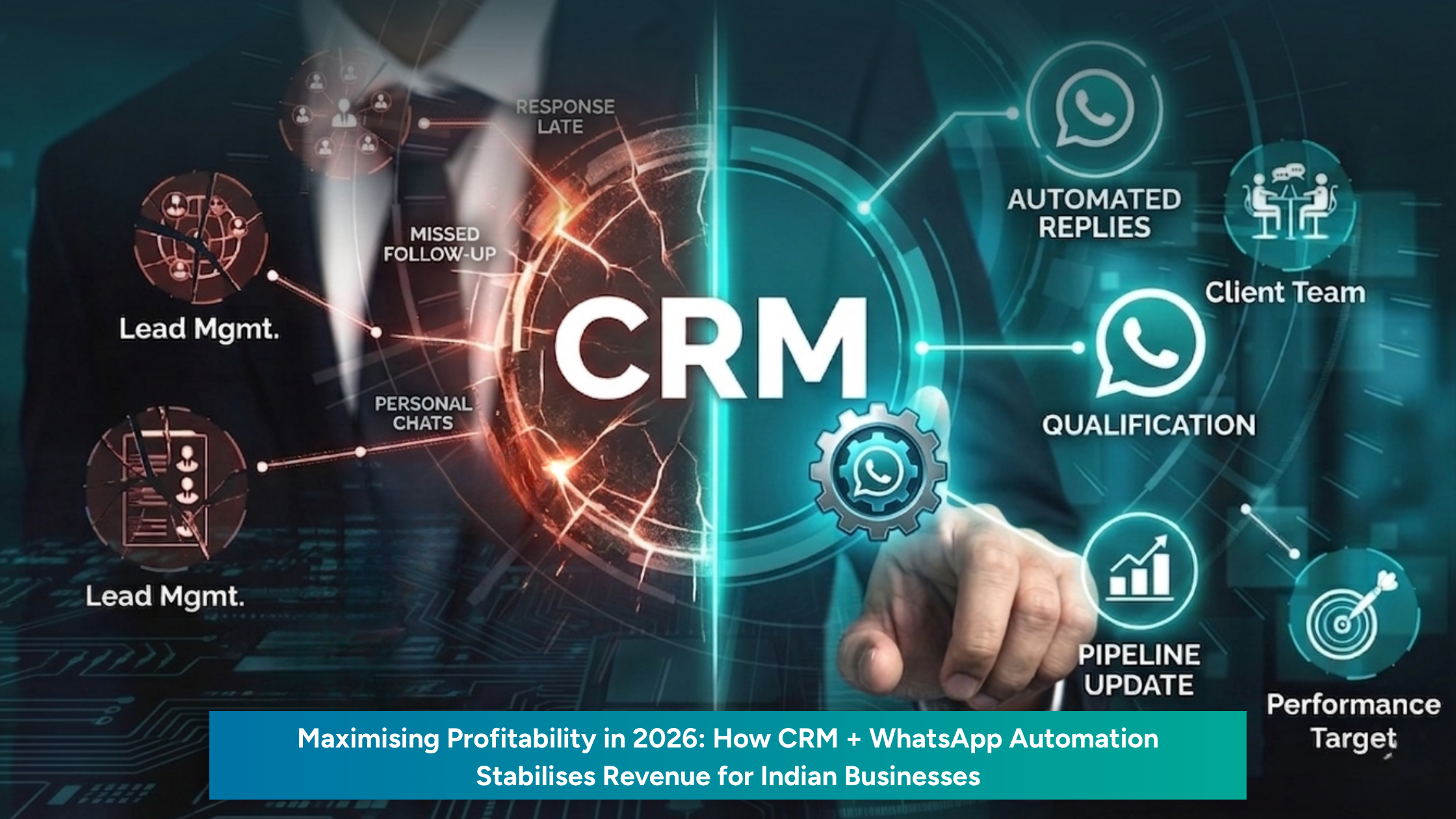
When you connect CRM + WhatsApp + follow-up systems, you don’t just “automate marketing.” You stabilise revenue by making lead handling reliable across the team. And in India, where WhatsApp drives a huge share of business conversations, this system becomes one of the highest-ROI upgrades a growing brand can implement.
This guide breaks down the solution in a role-based way, so founders, marketing teams, and sales teams know exactly what to own.
Table of Contents
Why enquiries stay high while revenue stays unstable
What most teams measure vs what actually matters
Many teams judge performance using top-level metrics such as clicks, reach, leads, cost per lead, and ROAS inside the platform. However, those numbers alone do not explain profitability.
However, real profitability depends on what happens after the enquiry, including response time, qualification quality, follow-up discipline, ownership clarity, and next-step conversion.
If a business generates 100 enquiries and loses 30 because replies come late or follow-ups don’t happen, it wastes budget silently. As a result, the dashboard may look active, but revenue still feels inconsistent.
In 2026, however, you need to ask a better question:
How many enquiries moved forward, and where did we lose momentum?
The Indian reality: WhatsApp drives conversion, CRM drives control
Most Indian businesses convert leads through WhatsApp. Customers prefer this channel because it feels faster and easier. As a result, response rates are often higher. Teams also handle it more naturally in day-to-day sales conversations.
However, WhatsApp alone creates several problems:
Leads often sit in personal chats, while follow-ups depend heavily on memory. As a result, teams cannot track stages properly, and owners struggle to see the conversion movement clearly.
Therefore, to simplify this, use this rule:
WhatsApp gives speed, while CRM gives visibility. In addition, automation brings consistency. Together, these three elements protect your revenue.
The role-based operating model: Who owns what
To make this system work, you don’t need more tools. You need clear ownership.
For Founders: Your job is revenue stability, not message replies
Founders lose money when lead handling runs inconsistently. Your role is to create structure and enforce a weekly rhythm.
Founder ownership in this system
- Define the pipeline stages (what “movement” looks like).
- Enforce response-time standards (same-day minimum).
- Make one “next step” mandatory (call, visit, demo, payment).
- Review pipeline numbers weekly (20 minutes).
Remove bottlenecks (proposal delays, unassigned leads, missed follow-ups)
Founder KPI dashboard
Track key metrics such as enquiries received this week, response time average, qualified leads count, next-step conversions, and closed won vs. closed lost.
When you track these numbers, you stop guessing and start managing more effectively.
For Marketing Teams: Your job is not just leads. Your job is to manage the qualified lead flow.
In 2026, marketing doesn’t end at lead generation. Instead, marketing also owns the quality of lead capture and the clarity of routing.
Marketing ownership in this system
- Set one campaign CTA (WhatsApp or form, not five options),
- Ensure lead capture collects context (service, city, timeline, budget range),
- Ensure UTMs and source tracking flow into CRM,
- Create response templates that match campaign messaging,
- Build retargeting audiences based on real intent signals.
Marketing KPIs that matter
- Lead source quality (which channel converts to the next step).
- Cost per qualified lead (not just cost per lead).
- Message match score (ad promise vs. WhatsApp flow vs. landing page).
- Drop-off points (where leads stop responding).
When marketing captures better context, sales can close faster and follow up more accurately.
For Sales Teams: Your job is to speed up the lead and move it to the next stage.
Sales teams lose deals when they reply late or let conversations drift. In India, where multiple vendors respond quickly, the first clear response often wins. Therefore, speed and structure matter just as much as lead volume.
Sales ownership in this system
Sales teams should respond within the defined time window, qualify leads using a short question flow, move every lead to the next step, update the CRM stage daily, and follow a fixed follow-up rhythm.
Sales KPIs that matter
- Speed-to-lead.
- Qualification rate.
- Conversion to the next step.
- Proposal turnaround time.
- Follow-up completion rate.
Sales doesn’t always need more leads. Instead, it needs fewer leaks in the follow-up process.
How to build the workflow: CRM + WhatsApp + follow-up
Step 1: Capture every enquiry into one CRM pipeline
First, stop letting leads live only in chats.
To make this practical, use stages that fit Indian buying behaviour:
Use stages such as new enquiry, contacted, qualified, visit/demo required, proposal shared, follow-up pending, closed won, and closed lost.
This gives the whole team one shared reality.
Step 2: Send an instant WhatsApp acknowledgement
This helps protect the first response window.
Your auto message should confirm receipt, set a response expectation, ask one qualifying question, and give one clear next step.
Example:
“Thanks for reaching out. We received your enquiry. Our team will respond within X hours. Please share your city and timeline so we can guide you faster.”
Step 3: Add 2–4 qualification questions
To keep the process simple, ask only what you need, such as the service requirement, city, timeline, and budget range.
This improves lead quality and speeds up closure.
Turning response into a repeatable process
Step 4: Build a follow-up rhythm
Use a simple cadence:
- Day 0: Response + qualification
- Day 1: Reminder + next step
- Day 3: Proof + reassurance
- Day 7: Decision-stage follow-up
At the same time, use templates to keep the tone consistent and human.
Step 5: Force a “next step” for every conversation
Every enquiry should move to one action, such as booking a call, scheduling a visit, requesting a quote, paying a booking amount, or scheduling a demo.
Otherwise, your team may keep chatting without moving the lead forward.
Step 6: Review weekly to find leakage
Use a 20-minute weekly review:
- Which source sent the best leads?
- Where did the leads get stuck?
- Which stage leaks the most?
- Which team member needs support?
- What should we change next week?
Over time, this weekly review helps stabilise growth.
What changes after you implement this
Most businesses see improvements within weeks. Response times become faster, and missed leads reduce. In addition, lead quality improves and more enquiries convert into calls or visits. As a result, closure becomes more consistent and the team works with less stress. Most importantly, revenue starts to feel more predictable.
Q1 2026 starter plan for Indian businesses (7 days)
- Day 1: Define stages in the sales pipeline + response time rule.
- Day 2: Set up CRM and lead source fields.
- Day 3: Connect WhatsApp enquiries and UTM tracking.
- Day 4: Write auto acknowledgement, FAQs, and qualification prompts.
- Day 5: Write follow-ups for Day 1, Day 3, and Day 7.
- Day 6: Add one clear next-step link (booking, visit, payment).
- Day 7: Schedule a weekly 20-minute pipeline review.
Final takeaway: “Lead handling is not a memory task; lead handling is a growth system”
In 2026, marketing does not end with generating enquiries. Instead, profitability depends on how effectively your team handles them afterward.
In India, WhatsApp drives conversion, while CRM brings control. On top of that, automation adds consistency. When you assign clear ownership across founders, marketing, and sales, you stop losing revenue to silent gaps.
Therefore, if you want stable revenue, build a stable lead-handling system first.
If you want support implementing CRM with WhatsApp workflows, including clean tagging, follow-up systems, and role-based accountability, a digital marketing agency can set up the system end-to-end so your team can focus on delivery and growth.
Let’s connect CRM, WhatsApp, and follow-up workflows so every enquiry has a clear next step.