
Table of Contents
How to Convert Meta Ads Leads With 3 Simple Systems in 2026
Running ads in 2026 is easier than ever, but converting Meta Ads leads profitably is still where most businesses struggle.
Most founders do not lose money because Meta Ads do not work. Instead, they lose money because their business systems are not ready to capture, follow up, and convert the attention those ads create. Ads amplify what already exists. With a clean lead-handling process, ads can scale growth. Without strong follow-up and tracking, they only scale chaos.
Before increasing your budget, ask one practical question:
Do we have the systems needed to turn Meta Ads leads into measurable sales outcomes?
This blog explains the three systems every founder should build by Q1 2026 before scaling ad spend and trying to convert more Meta Ads leads.
The Core Problem: Why Businesses Fail to Convert Meta Ads Leads
Founders often treat ads as the solution. In reality, ads are an amplifier.
When you run campaigns without systems, you usually see symptoms like these:
In many businesses, leads arrive but the team responds late or inconsistently. At the same time, people click and enquire without moving to the next step. Marketing may look active on the surface, yet sales outcomes stay flat. Reporting then becomes a dashboard exercise instead of a decision-making tool, and the team ends up adding more budget to “fix” the issue while the leakage only increases.
What Happens When Meta Ads Leads Are Not Managed Properly
This pattern creates frustration because ads bring attention, but attention alone doesn’t pay salaries. Systems turn attention into outcomes.
Now let’s solve this the right way.
The solution: Build three systems that make ad spend convert
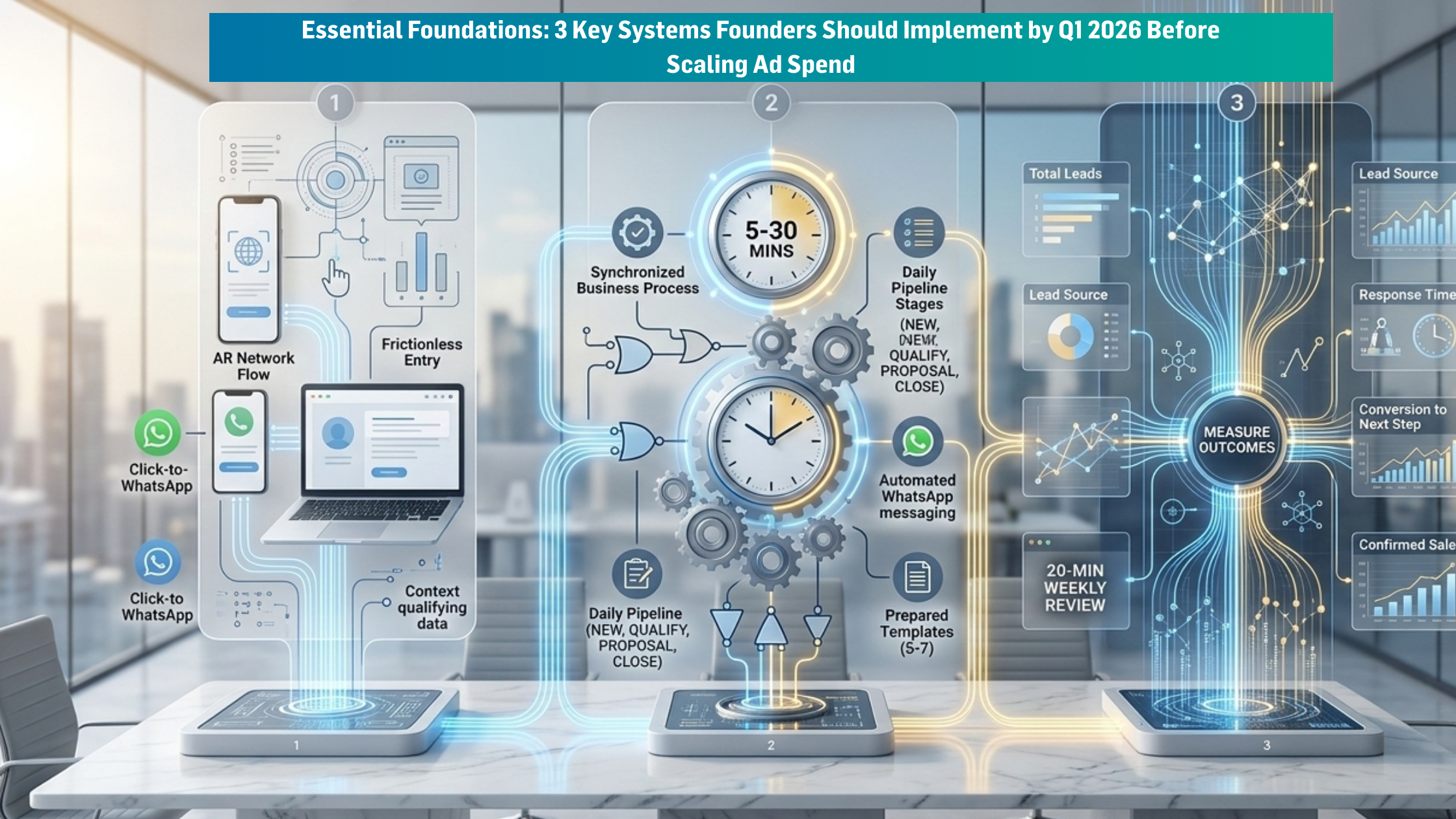
By Q1 2026, founders should build three simple, connected systems before scaling:
Lead Capture System
Lead Follow-up System
Measurement System
These are not enterprise processes. They are practical layers that protect your spend and increase conversion reliability.
System 1: Lead Capture System
Problem: Ads create interest, but businesses fail to capture and qualify it cleanly
Many ad campaigns fail at the first step. The ad generates clicks, but the business sends people in too many directions, or the capture flow asks too much, or the team captures zero context.
When lead capture breaks, you can’t improve results because you can’t measure intent. You can only keep running more ads.
What to build: A single-path lead capture flow
1) Set one core offer and one CTA
Every ad should drive one action:
WhatsApp enquiry,
Meta instant form,
call booking,
landing page conversion,
Avoid multiple CTAs in a single campaign. When you ask users to choose, you reduce action.
2) Make entry frictionless
People should be able to act in 10 seconds.
Use:
Click-to-WhatsApp,
Instant form with minimal fields,
A short landing page with one clear CTA,
Don’t make them browse your entire website before they can enquire. Ads work best when the action feels immediate.
3) Qualify inside the capture process
Capture a few essentials at the start so your team can respond with relevance.
Ask for:
What they need,
Location,
Budget range (or service tier),
Timeline.
You can do this using form fields or WhatsApp prompts. Qualification protects your time and improves conversion because your response becomes sharper.
What this system improves
Higher lead quality,
Faster, more relevant responses,
Better visibility into what people actually want,
Cleaner reporting and optimization later.
System 2: Lead Follow-up System
Problem: Businesses lose warm leads because responses and follow-ups lack structure
Most ad budgets don’t fail because the creative is “bad.” Lead handling fails more often.
Founders frequently see this:
A lead might enquire at 11 AM, yet the team replies only at 6 PM. In other situations, a prospect asks a question and never receives a follow-up after the first reply. Many businesses also leave leads inside WhatsApp or DMs without a clear pipeline, which forces sales conversations to restart from zero again and again.
Leads are time-sensitive. The first response window matters. If you don’t protect it, you lose conversion opportunities even with strong campaigns.
What to build: Speed + automation + pipeline discipline
Speed Matters When Handling Meta Ads Leads
1) Set a same-day response standard
Make this a non-negotiable rule. If your business can’t respond fast, your ads will keep leaking.
Aim for:
First response within 5–30 minutes during business hours,
Same-day response as a minimum standard.
2) Use WhatsApp automation for the first reply
Automation doesn’t remove the human element. It protects it.
Set up:
Instant acknowledgement,
FAQs and key details,
Next-step prompt (share details, book call, visit store),
That first automated reply keeps leads warm even when your team is busy.
Build a Simple Process for Every Lead
3) Run a simple pipeline that your team updates daily
Use CRM stages or a simple sheet. Keep it visible.
A simple pipeline could include these stages: New Contact, Qualified Lead, Follow-up Sent, Proposal Shared, Closed Won, and Closed Lost.
A visible pipeline creates accountability and shows exactly where leads get stuck.
4) Prepare follow-up templates so the team doesn’t improvise
Write 5–7 follow-up templates:
“Checking in” message,
Objection handling for pricing,
Timeline follow-up,
Gentle reminder with next step,
Final follow-up with a clear option,
Your team shouldn’t guess. They should execute.
What this system improves
Higher lead-to-call and lead-to-visit conversion,
Better close rates without increasing spend,
Less dependence on founder memory,
Stronger customer experience.
System 3: Measurement System
Problem: Founders track clicks and likes, but they don’t track business outcomes
Meta gives you plenty of numbers, but many of them do not help you make decisions. The real problem begins when teams skip weekly outcome tracking, because guesswork becomes expensive as budgets grow. Instead of building complex dashboards too early, focus on consistency and a simple weekly review rhythm.
What to build: A weekly 20-minute review using the “Big 5.”
Track these every week:
Total leads received,
Lead source (Instagram, Facebook, referral, walk-ins, Google),
Response time,
Conversion to next step (call, visit, booking, payment),
Confirmed sales or orders.
A simple weekly review creates clarity quickly. It also shows you what to improve before increasing the budget.
Add basic tracking so Meta optimization improves
Track the Right Numbers Every Week
Step 1: Start by Tracking the “Big 5 tasks” every week
Block 20 minutes weekly and review:
Track five numbers every week: total leads received, lead source, response time, conversion to the next step, and confirmed sales or orders.
Together, these five numbers give you better decision-making power than vanity metrics ever will.
Improve Tracking for Better Meta Optimization
Step 2: Strengthen tracking so Meta learns faster
If you use a website or ecommerce flow, set up:
Meta Pixel for key actions,
Conversions API (CAPI) for stronger signal capture,
UTM parameters for clean attribution.
If you skip tracking, Meta struggles to optimise and you struggle to diagnose problems.
Why this system matters:
When you measure weekly, you improve weekly. When you measure monthly, you guess monthly.
Run ads professionally in Q1 2026 (and stop boosting from a profile)
Many founders still use this approach of boosting posts from their personal accounts. This is not a scalable approach and doesn’t give you control.
Set up the right structure:
1) Meta Business Manager
Think of Meta Business Manager as your control center. From there, you can manage your Facebook Page, ad account, pixel and tracking access, and team roles in one place..
2) Pixel + CAPI
Pixel is what tracks what is happening on your website. CAPI is what you use when browsers are limiting data sharing.
3)Instagram Business Account + Ads Manager
With this setup, you unlock:
This setup gives you better analytics, fuller placement options, stronger control over Reels and Stories, and more consistent reporting.
It will not make ads magically work, but it does make your campaigns more trackable and scalable.
How to execute campaigns smarter in 2026
1) Use Meta’s structure properly
Meta runs on three levels:
Campaign: objective
Ad set: audience, placements, budget
Ad: creative and copy
Keep your structure clean so you can test and optimise without confusion.
2) Choose objectives that match your system strength
Pick the objective your backend can handle:
Awareness for reach
Traffic for visits
Engagement for WhatsApp or Messenger chats
Leads for instant forms
Sales for ecommerce conversions
If you can follow up well on WhatsApp, engagement-to-WhatsApp can work very well. If you can’t follow up quickly, don’t run a lead-heavy campaign and expect miracles.
3) Focus on short-form creatives that hook in 3 seconds
In 2026, clear and direct creative wins.
Use:
Use short vertical videos under 30 seconds, add a strong hook in the first three seconds, include on-screen text for silent viewers, and test UGC-style, founder-led, or customer-story formats.
Show the offer and the CTA clearly. Don’t hide the action.
A 7-day plan to build these systems before you scale spend
If you want a fast, practical Q1 plan, follow this:
For a practical Q1 rollout, define one core offer and one CTA first, then build your lead capture flow, set up WhatsApp auto-replies, create your pipeline stages, prepare five follow-up templates, and schedule a weekly 20-minute review for the Big 5 metrics.
This plan creates consistency. Consistency creates profitability.
Closing: Scale systems first, then scale spend
In 2026, you do not win by spending more. You win by building better systems to convert Meta Ads leads.
When you build lead capture, follow-up, and measurement systems, you reduce guesswork, improve performance, and protect both your time and budget.
Campaigns bring attention, but systems are what convert Meta Ads leads into real business outcomes.
If you want a partner to help you set up these systems and run Meta Ads with discipline, a digital marketing agency can build your capture flow, follow-up automation, tracking, and weekly review rhythm so you can scale visibility without leaking budget.
Quick reflection: Which system needs attention first for you right now: capture, follow-up, or measurement?
Let’s build the lead capture, follow-up, and measurement systems that turn ad spend into predictable revenue..