

Every founder we talk to right now is using AI in some form. A chatbot here, a content generator there, maybe an automation connecting two apps that used to require manual copy-paste. And yet, most of them tell us the same thing: it doesn’t feel like it’s actually changing how the business runs.
This Data supports that feeling. Recent industry research shows that while the vast majority of organizations now use AI somewhere in the business, only a small fraction have scaled it into how the enterprise actually operates. A large share of CEOs surveyed globally in early 2026 reported seeing no measurable return from their AI investments despite active deployment. The gap isn’t a technology problem. It’s a workflow problem.
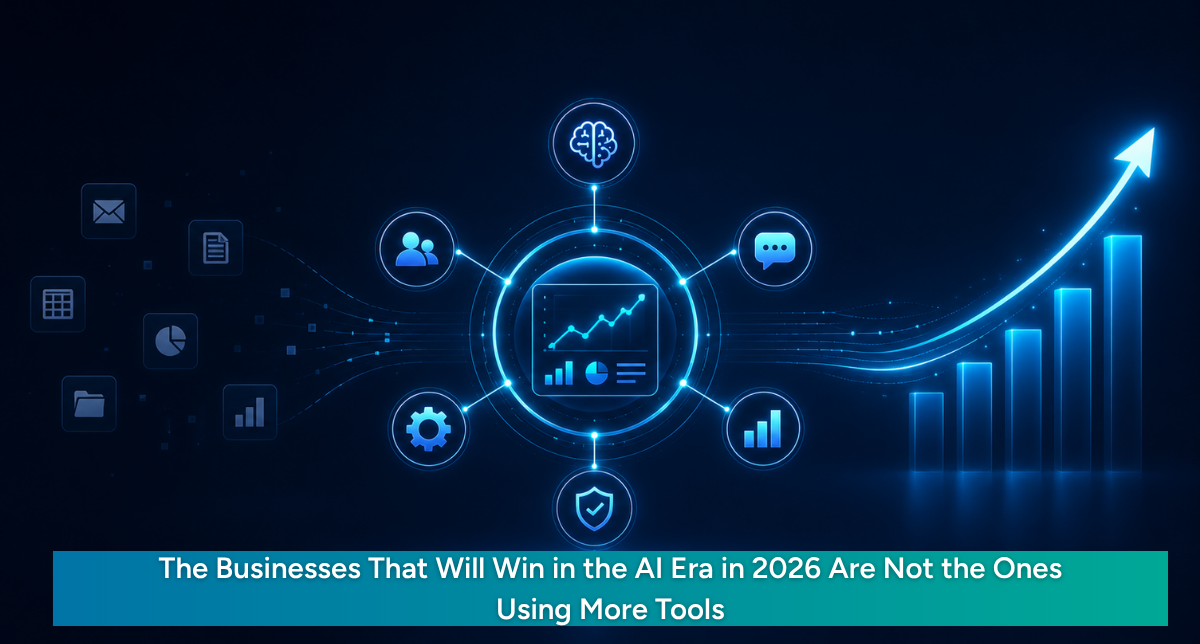
This is the real story behind AI adoption in business in 2026: the winners are not the businesses with the most tools. They are the businesses that redesigned how work moves, before adding the tools.
Table of Contents
The AI Tool Overload Problem
Walk into most growing businesses today, and you’ll find the same pattern. A content tool for social posts. A chatbot plugged into the website. A separate tool for transcribing calls. Another for drafting emails. Businesses usually adopt each one with good intentions, often to solve a specific, visible pain point.
The problem is that these tools rarely communicate with each other. The chatbot captures a lead, but it doesn’t automatically sync to the CRM. The call gets transcribed, but nobody built a step to turn that transcript into a follow-up action. The result is a founder who is using more AI than ever and still doing the same manual chasing, checking, and remembering they did two years ago — just with more subscriptions on the credit card statement.
This is what we mean by tool overload. It looks like progress because the business is “using AI.” But activity is not the same as structure. Adding tools without redesigning the underlying workflow usually just adds a new layer of noise on top of the old chaos.
The Real Bottleneck Isn't the AI Tools, It's the Business Process that uses the AI Tools.
When we sit down with founders for a growth audit, the constraint is almost never “we don’t have access to AI.” It’s things like:
– Inquiries coming in through five different channels — website, WhatsApp, Instagram DMs, calls, referrals — with no single place they all land.– A founder who is the only person who knows how to respond “properly,” so response time depends entirely on how busy they are that day.
– No clear step-by-step path from “someone showed interest” to “someone became a paying client.”
– Reporting that lives in someone’s head instead of a system, so nobody can say with confidence what’s actually working.
These are structural bottlenecks. No tool, however advanced, can fix a broken process by itself. In fact, dropping an AI tool into a broken process usually just makes the business fail faster and with more confidence, because the tool creates an illusion that something has been “handled.”
Why the workflow thinking comes before the AI Tool Selection
The businesses pulling ahead in 2026 are doing something deceptively simple: they are mapping the actual journey of a lead, an order, or a client — before deciding where AI or automation goes.
Workflow thinking means asking, in order:
- What is the outcome we want? (An inquiry converted, a customer retained, a report delivered.)
- What are the exact steps that currently happen to get there — including the manual, invisible ones?
- Where do things get delayed, lost, or forgotten?
- Which of those steps genuinely need a human judgment call, and which are repeatable enough to automate?
Only after this mapping does it make sense to choose the tool — whether that’s a WhatsApp automation to acknowledge every enquiry within minutes, a CRM stage to trigger a follow-up automatically, or an AI assistant drafting the first response so a human only needs to review and send. Industry data backs this order of operations: research this year consistently shows that organisational habits — clear workflow redesign, defined ownership, and measurement — now matter more than the technology itself in determining whether AI adoption in business actually pays off.
The Optimal Level of Implementing AI in Your Company
There are typically four different levels, and it is always useful to determine which level your company is on:
Stage 1 – Experimentation. The founder usually uses a variety of individual tools at random, without integrating them into a single clear system.
Stage 2 – Automation of Processes. Tasks like automated responses and scheduling have been in place, yet there is no workflow linking them.
Stage 3 – Workflow Integration. When enquiry gathering, follow-up, CRM updates, and reporting work together in one workflow, founders start seeing real results.
Stage 4 — Systemized Growth. The business runs on a connected system where AI and automation handle the repetitive work, humans handle judgment and relationships, and the founder can see what’s working without having to chase anyone for an update.
Most businesses we meet are stuck between Stage 1 and Stage 2, busy adopting tools but not yet redesigning the workflow those tools sit within. Moving to Stage 3 is where the real compounding advantage begins.
A Practical Adoption Roadmap for Growing Businesses
If you’re deciding where to start, this is the sequence that actually works:
1. Map your journey from enquiry to conversion first. List all the channels through which leads can come to you and list all the steps before they become customers.
2. Find the one leak that’s costing you the most. Usually it’s response delay or inconsistent follow-up, not visibility.
3. Fix that single workflow with the right combination of automation and human oversight. Start narrow — one workflow, two or three metrics, tracked for a full quarter.
4. Connect the systems, not just the tasks. Your website, WhatsApp, CRM, and reporting should feed into one place, not five.
5. Expand only after the first workflow is measurably working. Scaling too many workflows at once is the most common reason AI initiatives get abandoned within a year.
The Businesses That Will Actually Win
The businesses that win in the AI era won’t be the ones with the longest list of tools. They’ll be the ones who took the time to understand their own workflow, fixed the real bottleneck first, and used AI to support that system rather than patch over the cracks in it.
If your business feels active but unstructured, that’s usually the sign it’s time to look at the system underneath — not add another tool on top of it.
If your business is using AI tools but still feels scattered, let’s build the
system underneath. Book a Growth Consultation with Lamppost Digital and map what your business actually needs before deciding what to automate.