

Most growing businesses are active every day. They post on social media, respond to enquiries, maintain a website, run campaigns, create new content, try every new tool, and attend meetings. From the outside, everything looks busy. But busyness is not always growth.
Many business owners assume that more activity will naturally create more visibility, more enquiries, and more revenue. More posts, more campaigns, more videos, more platforms, more tools. But in reality, more activity without structure can create the opposite result. It can confuse the audience, stretch the team, weaken the message, and make the business feel even more scattered.
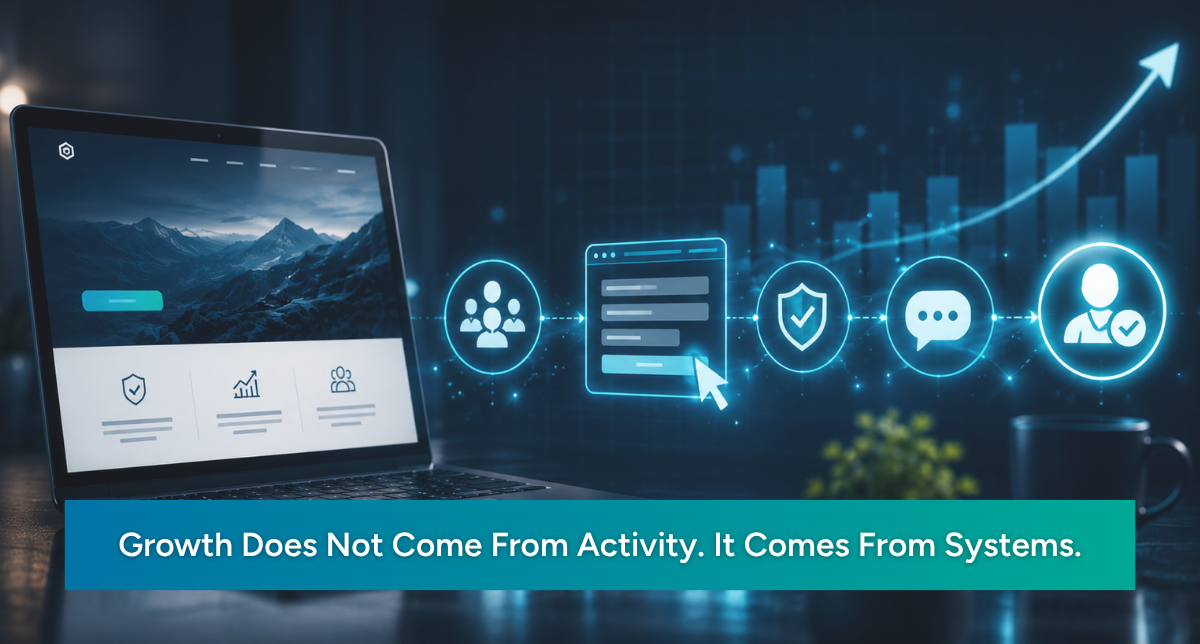
Growth does not come from doing more everywhere. Growth comes from doing the right things in the right order, with a system that connects visibility, enquiry, follow-up, conversion, and retention.
Table of Contents
The Hidden Cost of Doing More
There is an underlying cost to sporadic digital engagement. At first, the founder will not realize it, since the team seems busy and the brand is active. Eventually, however, the telltale signs will emerge.
Things are getting on, but there’s no engagement. Campaigns are running, but nothing is happening in conversions. Traffic is increasing, but nothing is getting done about it. There is lead generation, but there must be manual effort to reach the leads. The social media scene looks busy, but nothing is getting done to build the brand image.
This is what we refer to as the content-and-activity treadmill.
The business continues to produce, but growth does not compound.
In the case of service businesses run by women, this is evident in frequent posts without a clear service message. The owner may stay visible, and the brand may look professional, but the target audience may still not understand what problem the business solves or who it is meant to help.
For an educator, coach, trainer, or course creator, the problem may look slightly different. There may be strong knowledge, valuable posts, webinars, videos, or learning materials with them. But if there is no clear journey from content to enquiry, enquiry to enrolment, and enrolment to learning experience, the knowledge does not become a scalable learning business.
In these business scenarios, the problem is not effort. It is simply not connected.
More Content Is Not a Strategy
Content is important. Social media is important. SEO, blogs, videos, newsletters, and campaigns all have a role. But content alone is not a complete growth system.
If the firm publishes content without a defined core message, then the audience will get confusing messages from the brand. One week the firm addresses one issue, and then the following week it discusses a totally different issue. The CEO stays actively engaged, but the market does not know what to associate the brand with.
This creates a clarity problem.
It also creates a distribution problem. If the message keeps changing, even platforms struggle to understand who the content is meant for. More importantly, the audience struggles to connect the content with a specific need.
A strong brand is not built by saying many things once. A strong brand grows when you say the right thing consistently, with depth, proof, and relevance.
This does not mean reposting the same post. It means building around one clear belief.
For example, a service business may help clients move from confusion to clarity. A learning company may help learners move from information overload to structured progress. A consultancy business may help clients simplify business processes through practical systems.
Once the core message is clear, every blog, reel, carousel, email, webinar, and campaign can support that message from different angles.
At that stage, content becomes infrastructure, not just output.
What a Growth System Actually Means
A growth system is not a more complex setup. It is a clear setup flow that helps the business guide people to take the next important action.
It answers practical questions.
How does the right audience discover the business? What do they understand when they visit the website or profile? Where do they enquire? How quickly is the response? What comes after your initial discussion? How is the lead followed up? What helps the person decide? What happens after the action, like after purchase, booking, or enrollment?
When these questions are not answered, growth depends on chance and founder memory. When the business answers these questions clearly, it becomes easier to manage.
For a service founder, the system may include a clear website, strong service positioning, local visibility, enquiry capture, WhatsApp or CRM follow-up, booking flow, testimonials, and referral prompts.
For a teacher or for anyone developing a course, the funnel may include an anchor content piece, lead generation, nurturing through emails or WhatsApp, master class or consultation funnel, payment process, onboarding, reminders for learning, feedback mechanism, and next-level offers.
The tools may vary. The process is always the same.
The company needs visibility, but it needs to be ready for conversion as well. It needs inquiries, but it needs follow-through as well. It needs content, but it needs a journey as well.
What Indian Businesses Teach Us About Systems
One of the strongest lessons from India’s service and technology growth story is that scale is not created by doing random activities in high volume. Businesses create scale when they structure, repeat, measure, and connect their work.
The rise of India’s technology and outsourcing sector was not built only on working more hours or hiring more people. It grew because companies created process discipline, delivery models, documentation, handovers, quality checks, and repeatable ways of executing work.
That same principle applies to growing businesses today.
A founder-led business does not need to become large before it starts thinking in systems. In fact, the earlier the business builds simple systems, the easier it becomes to grow without chaos.
For a service business, it requires a process for inquiries and follow-ups prior to increasing their campaigns. For a course creator, it requires the process of learner journey prior to expanding their registrations. A product company requires product pages to be clear with retention flow prior to increasing traffic. The visibility via search engine results and inquiries management should come first prior to any other marketing activity by the local business.
Efficiency shall grow from hereon.
The 5-Step Clarity First Growth System
There is no need to create more content or launch a new campaign until businesses follow a simple clarity first system.
Step 1. Choose One Belief-Level Message
It starts from picking one belief-level message that your audience must remember. This message must help your audience solve some pain. It must be simple enough for understanding and influential enough to direct your content creation.
This message can focus on such aspects as trust, clarity, transformation, expertise for service business or structured learning, career growth, skills acquisition or confidence for the learning brands.
Without it, the content creation process becomes unstructured.
Step 2. Develop One Anchor Asset
Rather than attempting to create different unconnected posts, businesses must develop an anchor asset, which can be a comprehensive blog post, guide, webinar, video, checklist or founder-led article.
Its goal is to clarify your thoughts. It should educate the audience, show your point of view, and create trust.
Depth creates authority. Frequency alone does not.
Step 3. Break It Into Smaller Content
Once you prepare the anchor asset, break it into smaller content pieces. One blog can become social posts, email content, short videos, carousels, quotes, FAQs, and newsletter ideas.
This keeps the message consistent without forcing the team to think from scratch every day.
For small teams, this is very important. It reduces burnout and improves clarity.
Step 4. Distribute With Intention
Do not publish content only to fill the calendar. Every piece should have a purpose.
Some content should build awareness. Some should educate. Some should create trust. Some should move people toward enquiry. Some should nurture existing leads.
You can distribute the same message across the website, LinkedIn, Instagram, email, WhatsApp, YouTube, or Google Business Profile, depending on where the audience is active.
Creation is important but distribution is what will get the right people to see the content.
Step 5. Repeat This Process for 30 Days
Growth does not occur through weekly changes in the message. Rather, growth results through increasing clarity.
Within 30 days, the organization can focus on one single topic and observe what happens. Which posts have resulted in queries? Which post generated responses or savings? Which content brought traffic to the site? Which audience was more successful?
This review helps the business improve the system instead of randomly changing direction.
The Founder Should Not Become the System
In many growing businesses, the founder becomes the central system. The founder remembers the leads, follows up with clients, checks the campaign, explains the offer, tracks pending work, and decides what the team should do next.
This may work in the beginning, but it cannot support sustainable growth.
A founder should lead the vision, not carry every operational detail.
A simple growth system gives the founder visibility without forcing constant involvement. It helps the team understand the next step. It helps customers receive timely communication. It helps marketing become measurable. It helps the business move with more confidence.
That is particularly true for female entrepreneurs, consultants, educators, and experts who are likely to be juggling strategy, delivery, communication, selling, and personal lives all at once.
Systems don’t take the humanity out of business. They defend it.
Content Needs to Be an Infrastructure
The best companies don’t consider content as output but rather as infrastructure.
Good blogs serve SEO. Effective guides serve lead generation. Good videos build trust. Useful emails nurture. Case studies serve conversion. Testimonials serve decision making. When you connect content to a system, it keeps working beyond the day you publish it.
That is the difference between content as activity and content as an asset.
Businesses do not need to ask only, “How many posts can we publish this month?”
They need to ask, “Which content will move our business forward?”
This is a game changer.
Final Thoughts
The digital environment will continue to evolve. Technologies will evolve. AI will revolutionize searching, comparing, and decision-making. But the basics of business will not change.
Business will always require clarity, trust, visibility, inquiries, follow-up, conversions, deliveries, and retention.
So, before doing more, ask whether your current effort connects properly.
Is the message clear? Is the website supporting trust? Are enquiries captured properly? Is follow-up structured? Is content moving people toward action? Is the business learning from what is working?
Growth does not come from activity alone.
It comes from systems that turn effort into direction, direction into consistency, and consistency into sustainable business growth.
If your business feels active but still unstructured, it may be time to review your digital growth system. Book a Digital Growth Clarity Call and understand what needs to be connected before doing more.