

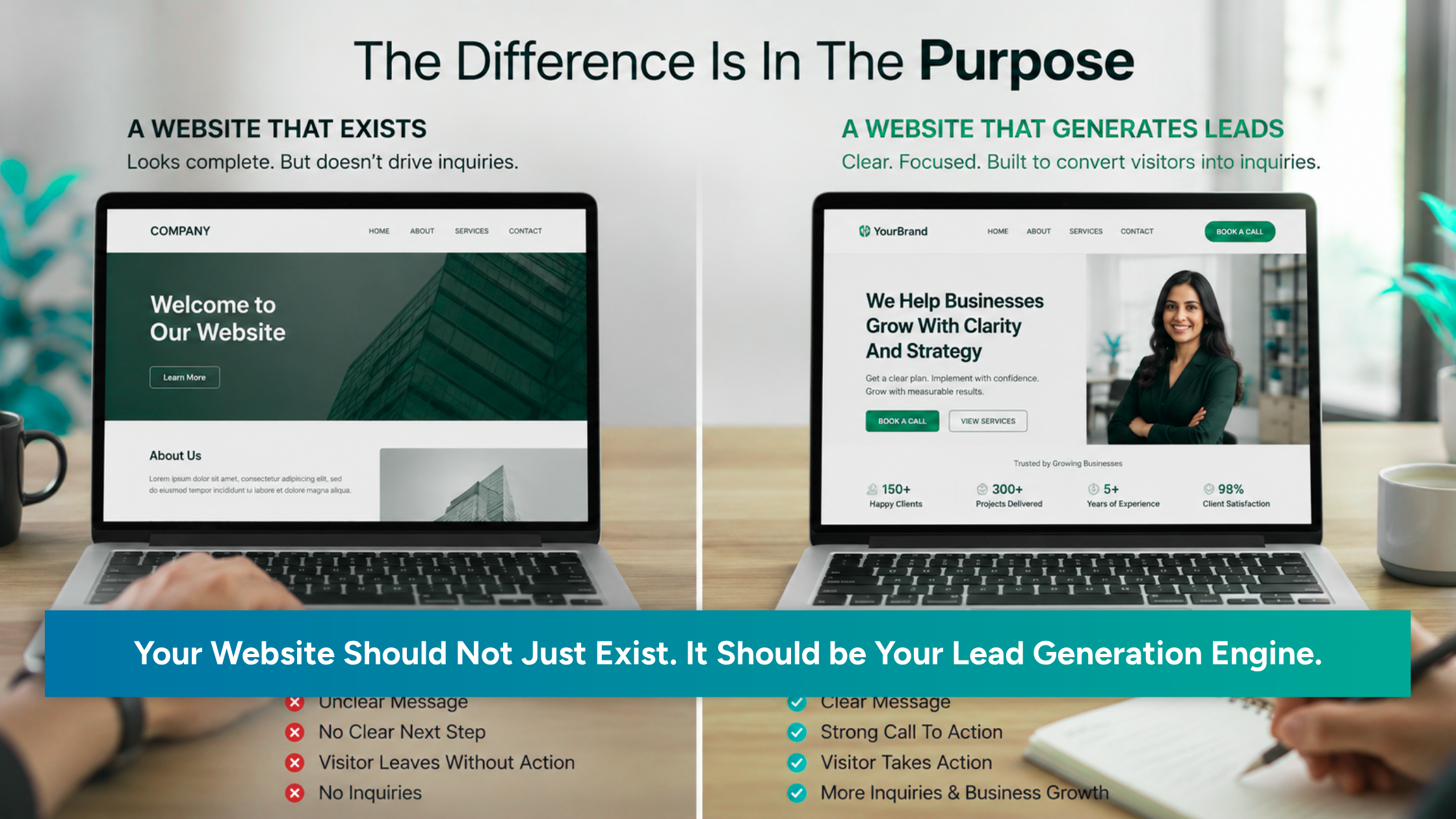
Most businesses in India have a website today. Many of those websites do not bring inquiries because businesses build them only to maintain an online presence. Many businesses create websites simply because they feel every business needs an online presence.
So the website sits online with a homepage, an about page, a services page, and a contact form. It looks complete, but it does not actively help the business grow.
A visitor may land on the website, look around for a few seconds, and leave without taking action. Not because the business is weak, but because the website did not make things clear enough. That is the real difference between a website that exists and a website that generates leads.
The ideal website must help visitors understand what you are all about, build trust in your organization, and know how to get in touch with you. For consultants, clinics, academies, manufacturers, coaches, service organizations, local firms, and product sellers in India, the website will serve as an excellent catalyst for growth.
Table of Contents
A Website Must Make the Business Easy to Understand
The first job of a website is to be clear. When someone visits your homepage, they should quickly understand what your business does, who you help, where you serve, and what they should do next.
Many websites use lines like “We provide quality solutions” or “Your trusted partner for success.” These lines sound polished, but they do not explain anything clearly.
A better line would be direct and specific.
For example, instead of saying, “We provide excellent training solutions,” a training business can say, “Practical digital marketing training for students, business owners, and working professionals in Chennai.”
That one line immediately gives context. It tells people who the service is for and what they can expect.
Clear messaging helps visitors decide faster.
Every Important Service Needs Its Own Page
Many businesses put all their services on one common page. This may feel simple, but it often creates confusion.
If someone is looking for website development, they do not want to read a general page that also talks about branding, SEO, ads, and social media. They want to understand that specific service clearly.
Each important service should have a dedicated detail page. A strong service page should explain:
* What the service includes
* Who it is for
* What problem does it solve
* What benefits does the customer get
* How the process works
* Common questions
* Testimonials or examples
* A clear inquiry option
This helps visitors better understand the offer. It allows search engines to better understand the website.
For example, pages around business website development, conversion-focused website design, or landing page design company services can attract people who are already searching with intent.
The Homepage Should Guide the Visitor
A homepage should not only welcome people. It should guide them.
Think of it like the reception area of a business. When someone enters, they should know where to go next.
For a great homepage, there should be:
A relevant headline, a short introduction, the services provided, why someone should choose us, Customer testimonials, Industries served, Contact details, and a Good CTA are a must.
The homepage needs to help visitors navigate to the relevant service page,/enquiry form/WhatsApp chat/booking page.
If the homepage feels confusing, visitors leave before exploring the rest of the website.
Trust Signals Make People Feel Confident
In India, people usually look for trust before they enquire. They want to know whether the business is real, experienced, and reliable.
That is why your website needs trust signals like Google reviews, Customer testimonials, Case studies, founder story, Certificates, Clientele, and Years of experience.
These details help visitors feel more confident. They reduce doubt and make the business feel more approachable.
A website without trust signals may look neat, but it can still feel incomplete.
Contact Options Should Be Easy to Find
Many websites lose leads simply because their contact options are unclear.
A visitor should not search for your phone number, WhatsApp link, or inquiry form. These details should be easy to find throughout the website.
A website for any business should always contain:
* Telephone Number
* WhatsApp Button
* Contact Form
* Email ID
* Map of the location
* Booking Link when necessary
* Prominent CTA Buttons
WhatsApp is a significant factor to consider for the Indian audience, who may prefer messaging over completing lengthy contact forms.
A simple “Enquire on WhatsApp” button can improve lead generation by making it easier to take action.
Call-to-Action Buttons Should Be Specific
A website needs to tell visitors what to do next.
Generic buttons like “Submit” or “Click Here” do not create strong action. Specific CTAs perform better because they align with the visitor’s intent.
Good CTA examples include:
* Book a Free Consultation
* Get a Website Quote
* Talk to Our Team
* Request a Callback
* Download the Brochure
* Enquire on WhatsApp
* Get Course Details
* Schedule a Demo
These CTAs should appear in the right places: the homepage hero section, service pages, testimonial sections, blog endings, mobile footer, and contact page.
The goal is simple. A visitor should always know the next step.
The Website Must Work Well on Mobile
Most Indian users browse websites on their mobile devices. So a website that looks good only on desktop will lose leads.
A mobile-friendly website needs: Fast loading speed
* Easy-to-read text
* Simple navigation
* Clickable phone number
* WhatsApp button
* Short forms
* Clear CTA buttons
* Proper spacing
If visitors have to zoom, wait, or struggle to click, they will leave.
Mobile experience directly affects inquiries. A good website should feel smooth and simple on a phone.
Local Details Help Local Customers Find You
For local businesses in India, location reach is most essential.
A clinic in Trichy, a coaching center in Coimbatore, a real estate consultant in Chennai, or a manufacturer in Madurai should clearly mention where they serve.
The website should include:
* City name
* Service areas
* Full address
* Google Map
* Nearby locations served
* Local testimonials
* Google Business Profile link
Local keywords also help bring relevant traffic.
For example:
* website development company Trichy
* Business website development in Chennai
* landing page design company in Coimbatore
* conversion-focused website design for Indian businesses
When location details are clear, customers and search engines better understand the business.
FAQs Help Remove Doubts
A visitor may like your service but still have questions. If those questions remain unanswered, they may delay the inquiry.
This is where FAQs help.
Useful FAQs can include:
* How much does the service cost?
* How long does the process take?
* To get started, visitors usually need to share a few basic details about their requirements.
* Do you provide support after delivery?
* Can I speak to someone before deciding?
* Is this suitable for small businesses?
* Do you provide customized solutions?
FAQs make the website more helpful. They also support SEO because many people search using questions.
A Website Should Capture Leads Properly
A website should not only share information. It should collect inquiries in a simple way.
Useful lead capture options include:
* Contact form, WhatsApp inquiry, Callback request, Brochure download, Demo booking, or Quote request.
But forms should stay simple. Long forms often reduce submissions.
For most businesses, this is enough:
* Name, Phone number, Email, Service required, and key Message.
The easier the form, the more likely people are to complete it.
Follow-Up Turns Inquiries into Business
Getting a lead is only the beginning.
Many businesses lose inquiries because they do not follow up properly. Someone fills a form or sends a WhatsApp message, but the response comes late. Sometimes businesses do not track those leads properly after receiving the inquiry.
A good website should connect inquiries to a follow-up system.
This can include:
* CRM
* Google Sheet tracker
* WhatsApp automation
* Email response
* Sales team notification
* Reminder system
Every business should know where the lead came from, what service they asked about, who followed up, what happened next, and whether the lead converted.
Without follow-up, website leads go cold quickly.
A Lead Generation Website Helps a Business Scale
A proper website supports the full customer journey.
It helps people discover the business, understand the offer, build trust, ask questions, submit inquiries, book calls, and make decisions.
That is why a lead generation website is not just a design project. It is a business growth system.
For Indian businesses that want to grow beyond referrals, word of mouth, and random social media inquiries, this kind of website becomes essential.
Final Thought
A website works well when businesses keep it clear, simple, and easy for visitors to use.
It needs to be clear, trustworthy, easy to use, and connected to a proper follow-up system.
When people understand what you offer, trust your work, and know how to contact you, the website starts doing its real job.
It stops being a dummy digital asset. It becomes a lead generation engine for the business.
Want your website to bring better enquiries? Build it with clarity, trust, and a proper lead generation system.