
The SEO requirements of 2026 demand that businesses implement better strategies than just boosting their website visitor numbers. The process requires businesses to attract specific search intent which should lead to ongoing customer inquiries. The website needs clear content together with trustworthy elements and defined user pathways to create successful lead generation from its rankings and impressions and blog traffic.
Many businesses are visible in search but still struggle with inconsistent conversions because their SEO stops at discovery instead of supporting decision-making. This blog post explains the reasons behind the gap and shows how work-focused SEO has become more important than visitor growth while identifying system modifications that improve business results from search traffic.
Table of Contents
The core problem: Traffic grows, but enquiry intent stays low
Many brands reach a common stage: website traffic increases, but enquiry quality stays weak. Leads don’t arrive consistently, and the ones that arrive don’t match your ideal customer.
When that happens, most teams choose the obvious move: publish more blogs.
That approach rarely solves the real issue. More content can even increase the wrong kind of traffic if you target broad keywords and generic topics. You end up working harder while outcomes stay unpredictable.
To fix this, shift your thinking from volume to alignment.
Your SEO must align with how buyers search, decide, and act in 2026.
The solution: Build SEO around four enquiry levers
Enquiry-driven SEO relies on four connected levers:
- Search intent alignment,
- On-page clarity,
- Local trust signals,
- Conversion pathways
Each lever removes a different blockage in the journey from search to enquiry.
Lever 1: Align with search intent
The Problem
Many SEO strategies still focus on broad keywords because search volume looks attractive. However, traffic from broad terms is not always ready to act. In 2026, stronger results come from showing up for what buyers actually type when they are ready to move
What intent looks like in real searches
Intent shows up in the language buyers use:
- “near me” and location phrases,
- “price,” “cost,” “best,” “reviews,” “top”,
- “for my business,” “for clinics,” “for coaches”,
- Problem-led phrases such “how to fix+<keyword>,” “solution for<Keyword>,” “not getting enquiries”,
- Comparison searches like “X product vs Y product ,” “which of the product is better”,
- Urgent searches like “book,” “consultation,” “call today,” “same day”,
These phrases don’t always carry a massive volume. They carry purchase intent.
How to find your best intent keywords without overthinking tools
Start with your sales reality.
Write down:
The questions people ask you on calls,
The doubts they share on WhatsApp,
The comparisons they bring up before buying,
The reasons they hesitate,
Turn these into search phrases. This simple method often produces your highest-converting keyword list.
Action for this week: List 10 searches your ideal customer might type right before contacting someone. Build pages and content around the relevant key terms,and not around any generic industry words
Lever 2: Fix on-page clarity
Problem
When someone clicks from Google, they don’t study your site. They scan. They decide fast.
If your first screen feels vague, your visitor won’t “read more.” They will exit and click the next result.
Build a five-second clarity layer
Your page should answer these four questions within seconds:
- What do you do?
- Who is this for?
- What outcome will they get?
- What should they do next?
Swap generic statements like “We provide digital solutions” with clear, outcome-led messaging that tells visitors exactly what changes after they choose you.
Example shifts:
- Shift From “SEO services for businesses.”
- To be more relevant, like “SEO that brings enquiry-ready traffic for service businesses.”
- From “We help brands grow online.”
To “We help brands turn search visibility into steady enquiries with intent-led SEO and conversion-ready pages.”
Make one action dominant
Choose one primary CTA per page:
- Click-to-WhatsApp,
- Click-to-call,
- Short enquiry form,
- Book a consultation
Then support that CTA with a short “what happens next” line, so the visitor feels safe taking action.
Clarity reduces hesitation. Clarity improves conversions.
Lever 3: Strengthen local trust signals
Problem
Local SEO does not work like traditional SEO. In many cases, users do not choose the “best” result. Instead, they choose the option that feels safest and most credible. So even if you rank well, trust signals often decide who gets the call.
Build trust where it matters
Strengthen local trust through:
- Consistent business details across your website and Google Business Profile,
- Accurate categories and service descriptions,
- Fresh reviews that sound real and specific,
- Photos that support credibility,
- Proof near the decision point, not hidden on another page
Also, align your website and Google Business Profile:
- Same name
- Same address and service area
- Consistent service list
- Matching phone number and contact routes
- Trust wins local search because trust reduces doubt.
Lever 4: Create clear CTA pathways
Problem
Many sites rank well and still lose enquiries because they do not guide action clearly. As a result, the visitor reads, scrolls, and leaves when the next step feels unclear or complicated.
Build conversion pathways that feel simple
Make enquiry paths easy:
- Click-to-WhatsApp,
- Click-to-call,
- A short form with minimal fields,
- A clear “what happens next” message,
- Design for mobile first. Most local and service searches happen on mobile. Every extra step increases drop-off.
If you want more enquiries, guide the visitor. Don’t leave them guessing.
Replace the ranking myth with the right question
Many businesses still chase one goal: “Rank #1.”
Ranking helps, but it does not guarantee leads. For example, a #1 ranking for a broad keyword can bring irrelevant traffic and waste effort. In contrast, a #3 ranking for a high-intent keyword can drive consistent enquiries because the search intent aligns with your offer.
Ask a better question in 2026:
Do we rank for searches that lead to action?
If your SEO reports discuss only rankings and impressions, you miss the real opportunity.
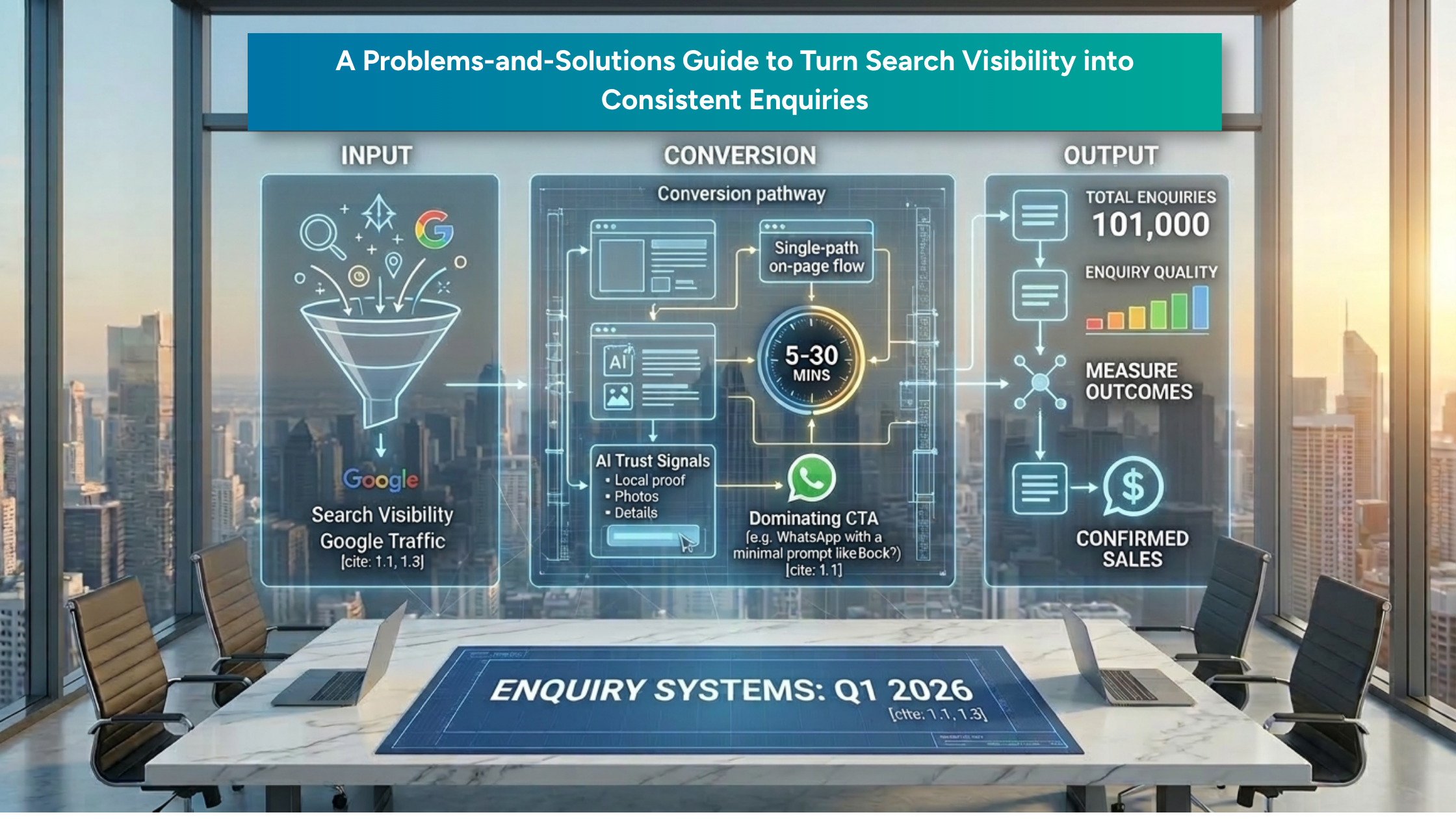
The system that makes SEO work in 2026: Seen → Chosen → Enquiry
Enquiry-driven SEO works best when you design a connected system, not a list of tasks.
Stage 1: Seen
Show up for searches buyers actually type, especially high-intent and local-intent terms.
Goal: earn visibility in the moments that matter.
Stage 2: Chosen
Win the click and build confidence quickly.
Do this through:
- Clear search snippets that promise outcomes,
- Outcome-focused headlines and structured pages,
- Visible proof and trust signals
Goal: make the decision feel safe.
Stage 3: Enquiry
Make the next step simple, quick, and guided.
Do this through:
- One clear CTA,
- Minimal friction on mobile,
- Proof beside the CTA,
- A clear “what happens next” line.
Goal: convert attention into action.
When you connect these stages, SEO becomes a lead engine, not a traffic project.
What blocks enquiries in 2026 (common SEO mistakes)
If you get traffic but not enquiries, one of these usually sits underneath:
- You may be targeting broad keywords instead of buyer-ready intent.
- You write content that ranks but doesn’t guide action.
- Your service pages list features instead of outcomes.
- You hide proof on a separate testimonials page.
- You show too many CTAs at once.
- Your Google Business Profile details and website information don’t match consistently.
- You track rankings but don’t track enquiries by page.
- You publish content without linking it to a next step.
- You don’t need more activity. You need better alignment.
The practical checklist for this week
If you want results, keep it simple and execute:
- List 10 high-intent searches your buyer types before contacting someone.
- Improve one service page headline to make it outcome-led.
- Add three trust elements near your CTA (review, proof point, process).
- Create one clear enquiry path (WhatsApp, call, or short form).
- Link your blogs to service pages with clear next-step links.
- Track enquiry sources weekly (Search, Maps, Social, Referral).
- Consistency beats complexity.
Closing thoughts: Clarity wins in 2026
In 2026, SEO success won’t belong to the loudest brands. It will belong to the clearest.
When someone searches, they do not want a long story. Instead, they want confidence, clarity, and a next step that feels easy to take
Ranking helps, but ranking is not the win.
The win happens when:
- You show up for high-intent searches,
- Your page makes the decision simple,
- Your enquiry path feels clear and low-friction,
- Your trust signals remove doubt.
Build SEO as a system: intent alignment, on-page clarity, local trust, and conversion pathways.
If you want to focus on running your core business while improving this system consistently, the right SEO agency can act as your search optimisation partner and manage enquiry-driven SEO execution with discipline and measurable outcomes.
Ready to turn search visibility into steady, enquiry ready growth?